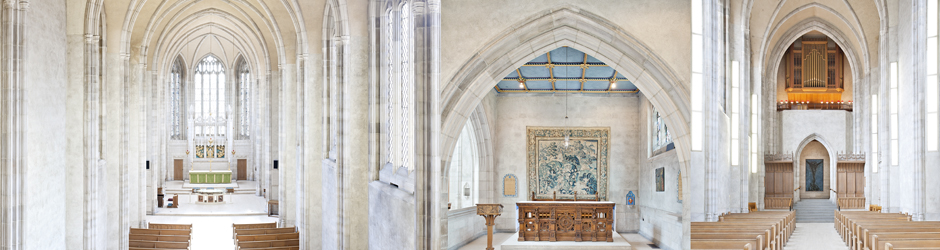
The Trinity College Chapel is the gift of the late Gerald Larkin (1885-1961), who headed the Salada Tea Company from 1922 to 1957. He contracted the renowned English architect, Sir Giles Gilbert Scott, who designed the great Gothic cathedral of Liverpool and, famously, the red Post Office telephone kiosks seen throughout England.
Trinity College held a celebration of the Holy Eucharist on the occasion of the 60th anniversary of the consecration of the Trinity College Chapel on November 18, 2015. The inspiring celebration provided an opportunity for reflection and prayer, and for the community to reconnect with each other. At the service, The Rev’d Canon Dr. Alyson Barnett-Cowan gave a beautiful Homily. To view photos from the service, please visit our Facebook page.
The Chaplain
The current Humphrys Chaplain to Trinity College and the St. George campus of the University of Toronto is the Rev’d Paige Souter. The Rev’d Souter looks forward to hearing from members of the college and university community about their hopes and wishes for the chapel and the chaplaincy. She can be reached at 416-978-3288 or trinity.chaplain@utoronto.ca.
The chaplaincy is a pastoral resource available to the entire College community regardless of religious background. The chaplain supervises Chapel services (in collaboration with the Director of Music and the Faculty of Divinity), offers programs and informal gatherings as a forum for those seeking to discuss spiritual questions, and provides pastoral counselling.
The Chapel hosts weekly services, and choir, and is also available for services and events like weddings, baptism, funerals and memorials.

Constance Larkin Knight Humphrys (1895-1975) was widowed at a young age, and worked in London, Ontario, as a milliner to support her children. Despite privation, she lived her Christian life with a sparkling and irresistible joy. She believed in doing everything possible to ensure that young people be given opportunities to better themselves, and because of her faith in God won the reputation of being an eternal optimist. She was not “preachy,” simply living out her trust in God through conventional, healthy, and cheerful action.
In 1995, the Rev. Margaret (Humphrys) Fleck and Prof. James Fleck established a fund of $1 million to endow the salary of the Trinity College chaplain. The position of chaplain was renamed “Humphrys Chaplain” in memory of Margaret’s mother, Constance Humphrys, and the additional responsibility of Anglican chaplain to the St. George Campus of the University of Toronto was added to the Trinity College chaplain’s job description.
The first Humphrys Chaplain was the Rev’d Dr. Robert Merrill Black, followed by the Rev’d John Beach, Humphrys Chaplain from July 2001-January 2006. The Rev’d Dr. Dana Fisher, third Humphrys Chaplain, served from July 1, 2006 to June 30, 2008. The Rev’d Andrea Budgey served from 2008 to June 30, 2025. The current Humphrys Chaplain is the Rev’d Paige Souter.
The Friends of the Chapel is an organization consisting of approximately 450 supporters, under the direction of an Executive Committee, working closely with the Humphrys Chaplain.
Friends support various aspects of the Chapel’s ministry: some Friends focus support on the Anglican chaplaincy at the University of Toronto; others sustain the choral, organ, liturgical, or ordination programs associated with the Trinity College Chapel. Many foster that symbolic place where lively, friendly and intelligent discussion about the Christian faith is housed.
For the first 30 years in the ‘new’ location on Hoskin Avenue, Trinity College’s chapel services were held in Seeley Hall, originally designed as the Library Reading Room. In 1953, work began on the present chapel; work was completed in 1955 and it was consecrated the same year on November 20 by the Most Reverend William Wright, Metropolitan of the Ecclesiastical Province of Ontario, with various Bishops, Archbishops, Provosts and the Governor-General in attendance. The chapel was a gift to the College from businessman Gerald Larkin, who orchestrated the substantial contribution of Canadian artists to the decorative features of the building.
The chapel was the last work of British architect Sir Giles Gilbert Scott (1880-1960), whose other designs include Liverpool Cathedral, the Cambridge University Library, and the famous British red telephone boxes. The local architectural firm was George and Moorhouse. Gothic in its structure, the chapel is built of solid masonry with load-bearing walls carrying a self-sustaining vault rib system with intervening spaces of acoustic treatment. The design is a simplified perpendicular Gothic style and is not a copy of any existing building. Traditional construction methods were used by European craftsmen; the only steel is in the hidden girders supporting the slate roof. The main chapel extends 100 feet to the reredos and is 47 feet high at the vault bosses. The exterior is sandstone, the interior a combination of Indiana limestone support and stuccowork, while the floor is Roman travertine.
The collaboration between Sir Giles Scott and Gerald Larkin produced an ecclesiastic space that achieves a sense of harmony and unified effect. Great restraint has been shown in the unadorned masses between the windows, the nearly monochrome expanses of glass, the simplicity of the pews. This restraint allows for the joyful discovery of individual elements within the chapel, and it allows the full brilliance and impact of the light to be felt. Sir Giles Scott visited the Trinity College Chapel only after its completion, and pronounced himself satisfied.