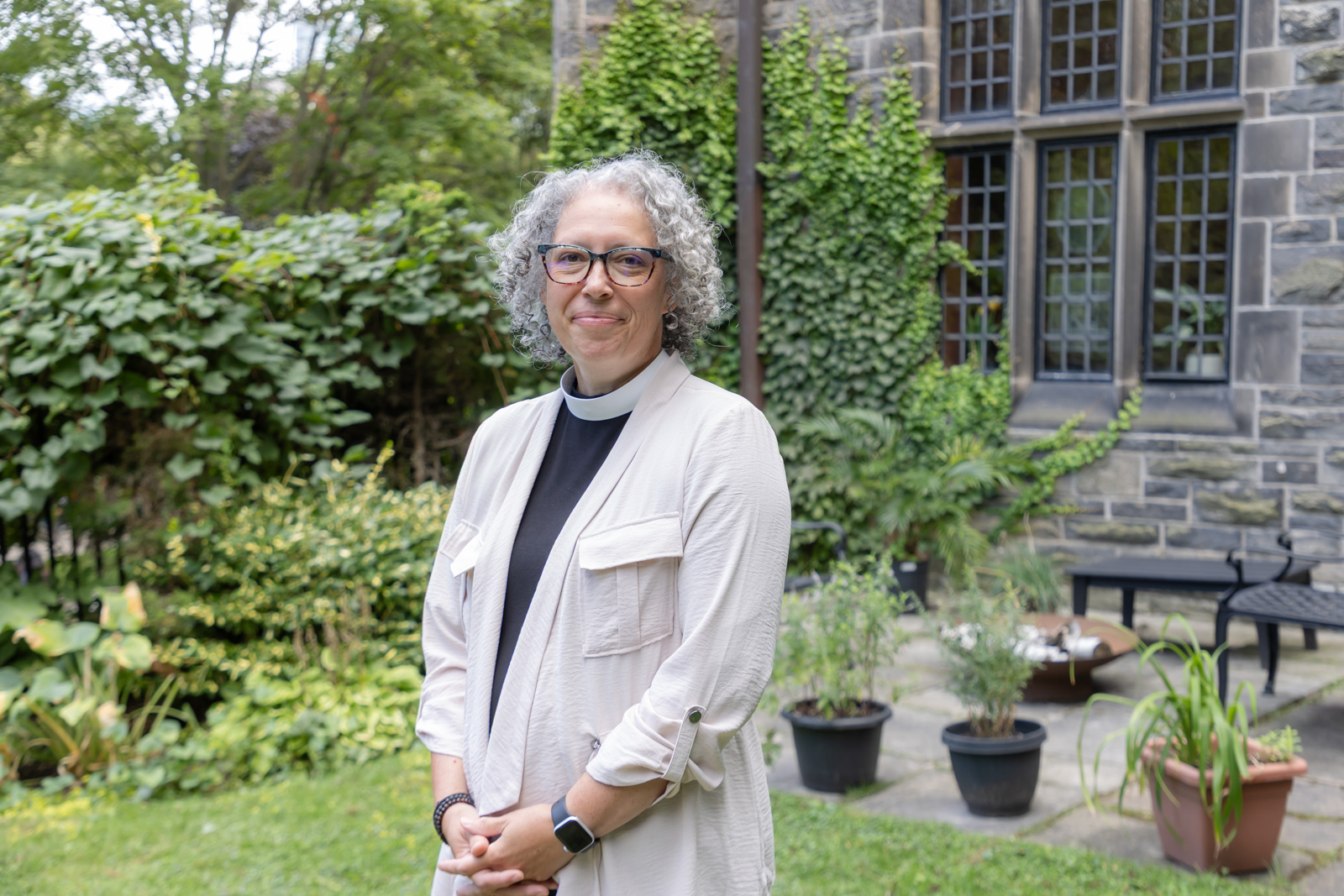

The Rev. Paige Souter (MDiv ’23) has joined Trinity College as the new Humphrys Chaplain, beginning her appointment on August 18, 2025. A Trinity alumna and the inaugural recipient of the Archbishop Desmond Tutu Scholarship, Souter brings a rich background in ministry, community development, and public policy to her new role. Returning “home” to the College, she looks forward to deepening connections across the community through a ministry of presence rooted in compassion, inclusion, and service.
1. You’re returning to Trinity as an alumna, having been Co-head of Divinity and the inaugural recipient of the Archbishop Desmond Tutu Scholarship during your Master of Divinity studies here. How does it feel to come back “home” in this new role, and how has your Trinity experience shaped your approach to chaplaincy?
To return to a community that I call “home” as chaplain is a full circle moment. Trinity is more than a campus; it is a community. It is a true joy to give back to a community that has given me so much. Building community and being present with people, being alongside them on their life journey has been a part of my career and ministry for a long time, and having the opportunity to do that now at Trinity is a gift.
I started at Trinity during the first year of COVID, when the campus was shut down and every class was online; we were all living in isolation. When life began to slowly open, I witnessed the difference that face-to-face encounters made not only here at Trinity but also in the rest of my life. The joy of being in proximity to each other glowed on our faces. As a student leader, I was committed to supporting and encouraging students as we tried to find our way through the new normal. Being together mattered.
My experience of Trinity as a student was of being seen, of being invited to share my leadership gifts, of knowing what it means to belong. These are foundational elements of what it means to being fully human. It is my hope that in serving as chaplain, I can do for students what was done for me — to be present, to walk alongside, to be an encouraging and supportive presence as students, alumni, faculty and staff undertake their respective work and strive to be their best selves.
2. What are the challenges for an Anglican chaplain creating inclusive programming and a welcoming presence in a multifaith community? How do you serve everyone?
For me, there are no challenges or contradictions in serving everyone. A ministry of presence is grounded in love for all regardless of one’s faith tradition or no tradition. Mine is a ministry of “witness” — journeying with people as they face challenges and celebrate joys. I have had the honour of participating in different religious ceremonies and learning about different traditions from those who live in those traditions. It has enriched my life and faith. It is a sacred thing to share our experiences with each other with open hearts and minds, curious as to how the divine lives in each tradition. I have also had the blessing to volunteer for a national inter-faith organization working with people from different traditions to build awareness of the impact of climate and environmental issues.
It often surprises people to learn that most religious and spiritual traditions share the same core values. I often use the example of the Golden Rule. In the Christian tradition we express this as “do unto others as you would have them do unto you.” In Buddhism it is expressed as “Treat not others in ways that you yourself would find hurtful.” In Judaism, “What is hateful to you, do not do to your neighbour. This is the whole Torah; all the rest is commentary.” In Hinduism, “This is the sum of duty; do not do to others what would cause pain if done to you.” And in Islam, “Not one of you truly believes until you wish for others what you wish for yourself.” I could go on, but I hope you see the point. Yes, there are elements of our traditions that are different — the divine loves diversity. But to be present with someone only requires one thing — a listening heart and an open spirit.
3. Your background uniquely combines urban planning, public policy, and theology — along with extensive experience in community development and information technology. How do these seemingly different fields inform your work with students navigating both academic pressures and bigger questions about purpose and meaning?
There is one thing that I have learned and continue to learn on my life journey, that there are experiences that we all share. While our journeys are varied, to be human means that we have universal experiences for longing, to be loved, to be belong, to heal, to be whole, to make a difference. In other words, to find purpose and meaning. Regardless of one’s field of study or career path, or whatever the work may be, one becomes aware that there is more beyond the “what” of what we do. We begin to enter into the realm of “why” we do what we do, and “who” am I or who am I becoming as I do this work. It is natural to ask oneself, “Does this work fit me?”
My varied and changing careers paths emanated from moments of longing for more. I am grateful that I had wise people who helped me navigate this terrain. And I have been blessed to encourage and support others as they explore, discern, and discover answers to these questions. We are always changing and it is wise to have trusted companions along the way.
4. Climate action and social justice have been central to your ministry, from your work with the Bishop’s Committee on Creation Care to the community development initiatives you’ve championed. How do you see the Chapel and chaplaincy contributing to Trinity’s broader conversations about these urgent issues?
This is a great question. The chapel, both in terms of the physical space as well as the spirituality of the place, requires that it be a place of dialogue, exploration, challenge, and action. As a priest and more importantly as a follower of Jesus, I am called to work for justice and peace. My ministry is rooted in Matthew 25:40. Jesus tells his disciples that “whatever you do the least of my brothers and sisters you do to me.” I live that out in many ways, and I envision a chapel and a chaplaincy that is engaged in justice issues at Trinity College, in the broader St. George campus, and in the community. That means hosting conversations as well as supporting conversations, being active on issues, and providing opportunities to serve and support community services in the neighbourhood. I have two short examples: First, for Truth and Reconciliation Day the chapel service focused on the trauma caused by residential schools. And it was a joy to work with the Wellness team to plan Trinity’s TRC events. Second, I am committed to ensuring that LGBTQ2S+ people from across the university have a safe place to gather for prayer in the chapel. I am thankful for the relationships that have been formed and are growing, and that we have been able to make the chapel available.
5. As an alumna connecting with the Trinity community, how would you like to invite alumni to continue engaging with the spiritual and communal life of Trinity?
I am so excited to connect with alumna and eager to hear their stories about Trinity and the meaning that this community has for them. I want to explore their dreams and hopes for the chaplaincy. What programming would they like to experience? What are topics and themes for discussion? Are they passionate about music in the chapel, about different types of liturgy, about theological discussions, about social justice discussions and actions? I invite alumni to become advisors and friends of the chapel, to share their giftedness, leadership and passion. I extend an open invitation to call upon the chaplaincy for support and encouragement in their lives. I am here for them.
BONUS QUESTION: What do you like to do when you step away from chapel duties — books, music, nature, hobbies? What replenishes you?
When I am able to step back from chapel duties, I am restored by reading, writing, being in creation, hiking and swimming, gardening, and watching Formula 1 racing.