The Advent Carol Service will see the debut of a new musical composition by Trinity College Music Director and Organist, Thomas Bell. And All that Therein Is was commissioned by the College to celebrate celebrating the 175th anniversary of the College. Using the Salt Shaker’s famous five question format, The Rev Dr. David Danner MDiv ’78, PhD ’23 sat down with Tom Bell and asked him about his new piece.
David Danner: Tom, can you tell us a bit about how the new composition came to be?
Tom Bell: The composition was requested by the Provost, Nicholas Terpstra, and Ana White, Executive Director Development and Alumni Affairs at Trinity College in the Spring. Both were looking forward to celebrating the 175th anniversary of the College and suggested that a musical work might be a fitting way to do this. Previous anniversaries have been celebrated by commissioning music from Hugh Bancroft (a well-known Canadian composer in the 1950s), Giles Bryant (longtime organist at St. James Cathedral) and last year, from Dylann Miller. Commissioning music is a wonderful way to mark a milestone as the premiere carries with it more than a frisson of excitement, and further performances are a beautiful gift to the future: the world needs as much artistic creation as we can summon!
DD: The text of the piece is really striking. Please tell us about it.
TB: Finding a suitable text is always the first task of a composer writing for choirs. Given Trinity’s commitment to sustainability I searched for writings based upon creation, and commentary upon our present difficulties. I also wanted the texts to be poetic and suitable for use in our services in the chapel and further afield. The psalms seemed to be a good starting place, and so I gathered verses from some of the more celebratory and hopeful psalms. But I also wanted commentary upon the ecological crisis we are experiencing and have used quotations from Pope Francis’ encyclical Laudato Si (2015), which focuses upon climate change and inequality, and placed them beside related sayings from St. Francis of Assisi. This multiplicity of textual sources is bound together by a refrain, sung in Hebrew, The earth is the Lord’s and all that therein is, from which the music takes its title.
DD: I can well understand having a song in your heart which you feel inspired to express in a composition, but what about a commissioned work such as this where you are given the theme. Is the composition process different?
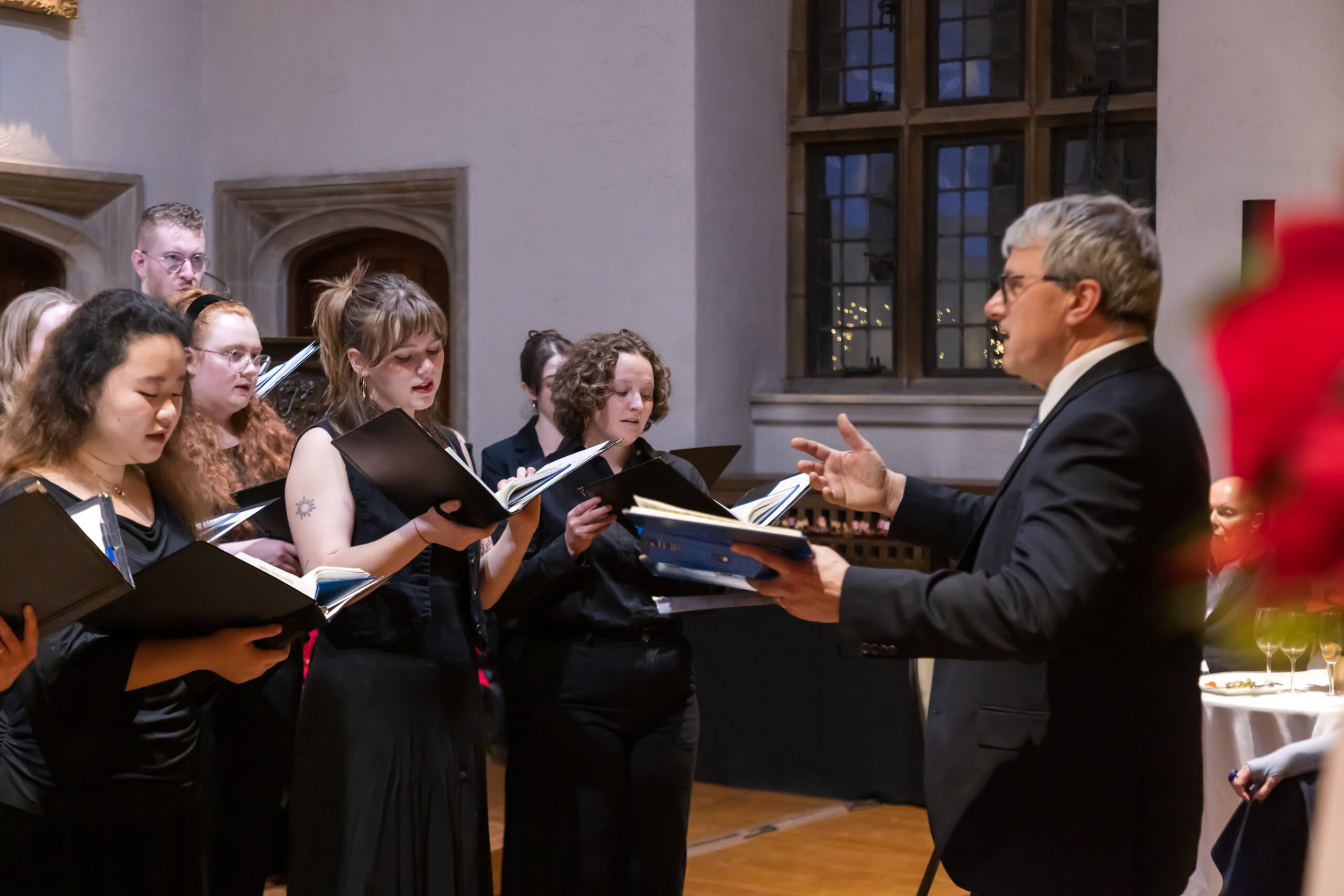
TB: I wanted to write music which captures the ebullience and youthful vigour of the music making in the Trinity Choir loft, but at the same time had a maturity and complexity. The music is quite simple in terms of structure and harmony, but more asymmetrical rhythmically, especially in the last section. It is scored for SATB choir, organ and soprano saxophone, the latter lending the music an ancient/modern feel. The composition lasts about 8 minutes.
Sometimes the lure of wishing to be original presents an obstacle to creativity. I love C. S. Lewis’s remark about originality, “no one who bothers about originality will ever be original: whereas if you simply try to tell the truth (without caring twopence how often it has been told before) you will, nine times out of ten, become original without ever having noticed it.” Inevitably, there are parts of the work which sound like any number of other composers (I was beset by doubts: does the opening sound too like a film score by John Williams? Do too many echoes of Renaissance music colour in the softer middle section?) but I think whatever new musical voice is present comes from responding to the beautiful texts and writing for the Trinity Choir…
DD: The Trinity Choir is doing very well. To what do you attribute that? Are there any advanced dates of upcoming performances we should put on our calendars.
TB: That’s very kind, David. I have had five very happy years at Trinity, and the music making in the chapel has been central to that. Many students tell me that membership in the choir has been a great point of release from the pressures of an academic life which sometimes feels overwhelming. Singing is in itself a great pleasure, and that pleasure is doubled when singing with others. The singers come to make great music but stay for the community. A community which surrounds itself with lovely music: I can’t think of anything better!
DD: Finally, do you have any plans or performances you would like to share?
TB: We would love to continue expand our musical offerings both from the choir loft – supporting our wonderful chapel community – and in the college and beyond. We have had some thoroughly enjoyable performances singing in Strachan Hall, and in Elora and Niagara-on-the-Lake. Who knows, perhaps we can have a more extended visit somewhere further afield in the coming years. Our next concert is at ‘home’ – in the college chapel – on Monday, March 8, 2026 at 7.30 p.m. when And All that Therein Is will be reprised.
Other plans include to continue to restore the college chapel organ, and to commission some further music. However, I suppose that my greatest wish is a simple one: that the choir improves musically each year, while always taking pleasure from each other’s singing and company week by week.
There’s probably much more, but I hope that this helps as a starting point. Thank you again, David.
And thank you, Tom, this has been excellent.