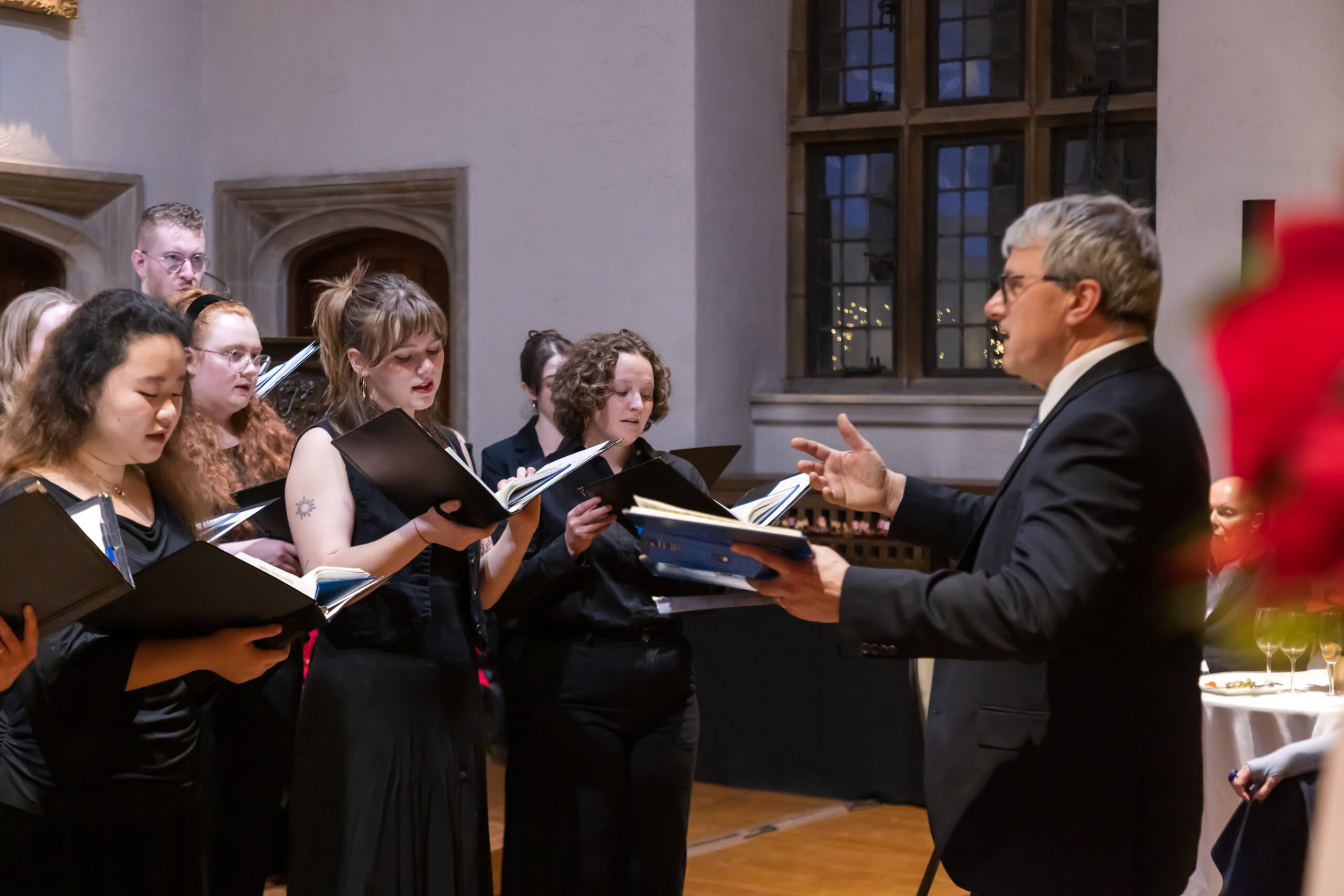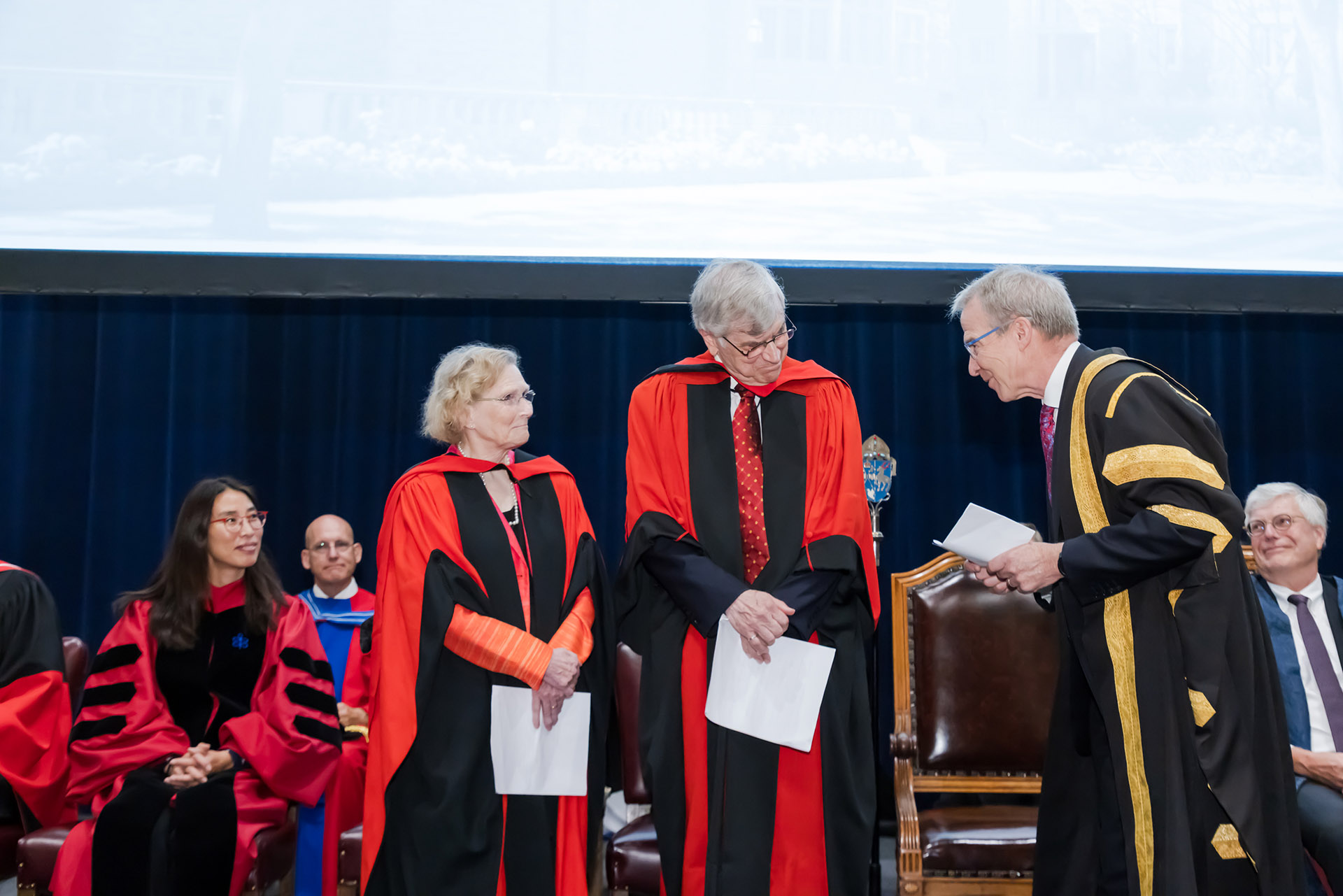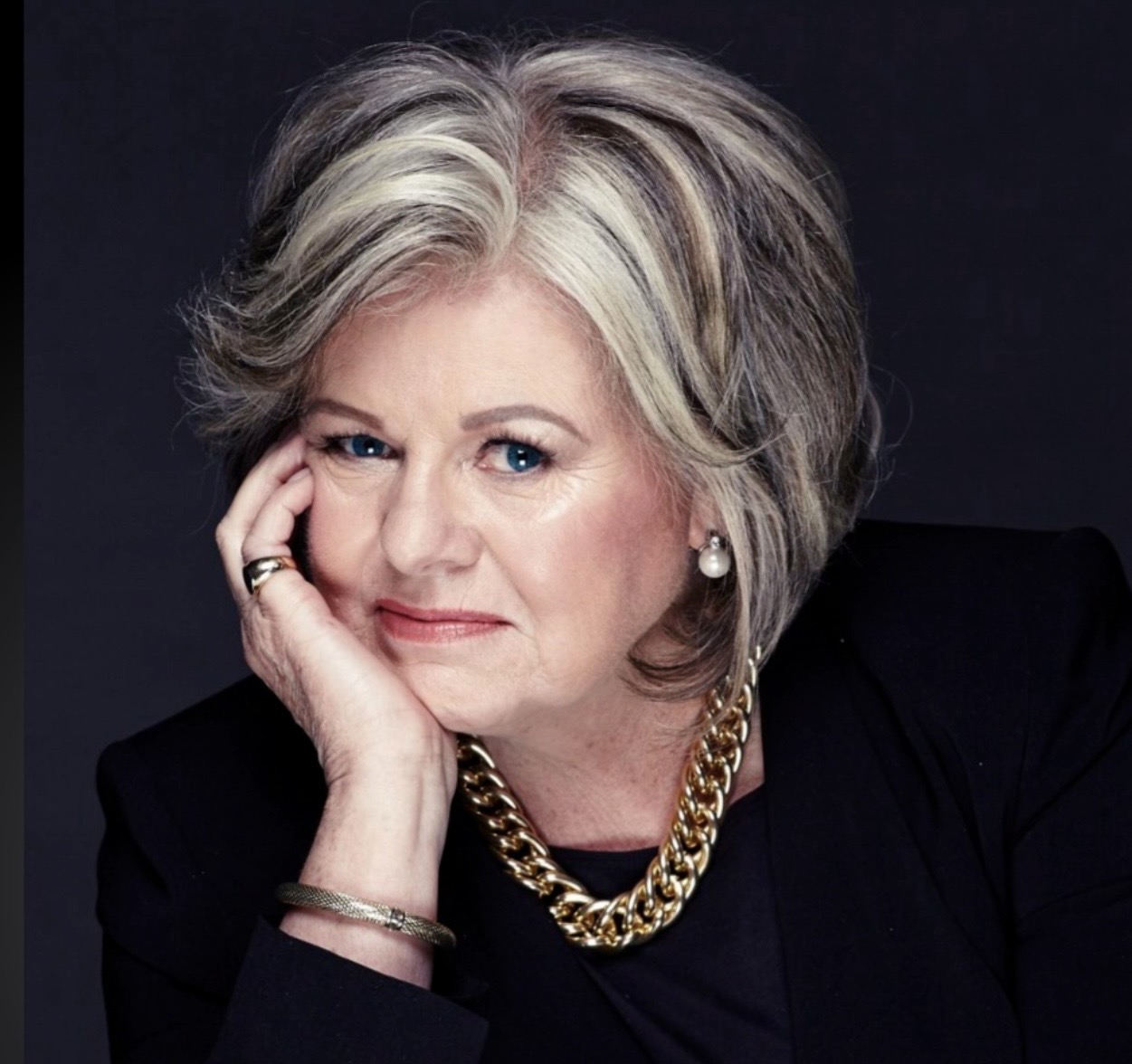
The Rev. Canon Dr. Judy Rois (ThM ’01), Trinity alumna and long-time lecturer in homiletics in the Faculty of Divinity, shared reflections with the Rev. Dr. Matthew Cadwell (PhD ’13) on her life in ministry in this 50th anniversary year of the ordination of women to the priesthood, and her own 40th anniversary of ordination.
Congratulations on the new hymn you composed in honour of the 50th anniversary of the ordination of women to the priesthood in the Anglican Church of Canada! Can you tell us about your inspiration and themes that were especially important in your composition. How can we access the hymn for congregational use?
50th Anniversary Hymn – “Guide us, O God with Blessing”
Words: Judy Rois; Tune: Lancashire
Musical Score: Christopher Dawes
At one of our Anniversary Committee Meetings, I raised the subject of commissioning an anthem for the closing liturgy of the National Conference in Victoria, BC for the 50th Anniversary of the Ordination of Women in the Anglican Church of Canada. We all agreed, and I was tasked with researching the possibility. As I was doing this, it came to mind that I might be able to write a hymn that we could all sing together, and that could be shared with parishes across Canada.
And so, I went to work, choosing first a well-known tune, Lancashire composed by Henry Smart, one of the most prominent romantic organists, composers, and hymnologists of the 19th century, a tune most famously sung to the hymn, Lead on, O King Eternal.
I began by thinking of the hymn as a prayer of thanksgiving that turns an anniversary into a renewed calling. My hope was to celebrate a commitment to prophetic courage, shared belonging, peace, and justice.
The hymn has 3 distinct verses:
- Belonging and purpose
- Calling and courage
- Inheritance and responsibility
The words attributed to God are guide, shepherd, feed, and lead, making divine care active. The congregations responds with actions of its own: living, loving, joining hands, walking, and fashioning a future.
I tried to place women’s ministry within a long inheritance of biblical women: Hannah, Deborah, Mary, and Anna who offer several forms of spiritual authority: prayer, leadership, song, prophecy, and wisdom.
Access to the hymn is currently on the home page of the Anglican Foundation of Canada or by email. Parishes may sing the hymn during the 2026 anniversary year, or really at anytime that suits their liturgical schedule.
This year you are celebrating your 40th anniversary of ordination to the priesthood. When did you first encounter ordained women, and how did you discern your own call to ordination? Who were your mentors in ministry?
I was ordained a deacon in 1985 at age 31 in Toronto at St. James’ Cathedral and a priest at age 32, at St. Aidan’s Anglican Church. I have often said that you can’t aspire to what you cannot see. When I looked around for role models, there were some to be sure, but not many. So yes, I looked to those who had been ordained to see how they engaged in ministry, even how they looked and sounded. In the early days, it was a time of navigating a road where only a few had travelled. Victoria Matthews and Ansley Tucker were probably my first role models in the Diocese of Toronto.
I can’t say exactly when I discerned a call to ordained ministry. It was a gradual process. I grew up in the Lutheran Church in Calgary, Alberta where church attendance wasn’t an option. It’s just what our family did. And I loved it. I loved the smell of old wood paneling and the colours of altar frontals and vestments. I’m not sure I had words for it, but from a very young age, I felt a kind of awe, mystery, and wonder when I was in church. It was in my late teens when our family moved to Toronto that the spiritual dimension of my life was fed by music, literature, architecture, and the comfort of rituals. I became an Anglican and Choral Evensong became a staple in my spiritual life.
Again, years passed. I completed an undergraduate degree and lived in France where I spent alto of time in the American Cathedral in Paris. My spiritual life was once again deeply formed by its ritual, tradition, gothic architecture and music. I remember meeting a woman there. I’m not sure if she was called a Sexton or a Steward (I forget just now) but I remember watching her clean and polish the pews on many occasions. She undertook her work almost “sacramentally,” that is, she had such respectful regard for her polishing cloth and the way she gave luster and shine to the pews with such refinement and elegance. I remember thinking this is the way that a priest handles the sacrament of bread and wine. I have thought of her often over the years when I was presiding at the Eucharist. It was there I decided to return to Canada and theology to see where that path took me. In time, with the encouragement from some wonderful mentors, I did come to think, albeit reluctantly, very reluctantly, that perhaps I might consider ordained ministry.
The Tale of Three Mentors
The Rev. Taylor Pryce – St. Leonard’s Anglican Church, North Toronto
In the early 1980’s, if someone was considering ordained ministry, they were interviewed by three people who then sent a report to the Bishop of Toronto. I considered my interview with Taylor Pryce to be nothing short of a disaster, given my nervousness and apprehension about ordained ministry. I remember that he asked me to describe my ecclesiology. If I even knew what the word meant, I certainly had no ability to cobble together a coherent answer. I told him this was all a big mistake; that I was sorry to have taken his time and asked if we could end the interview.
Once the Bishop of Toronto had received the report, he asked me to come to his office. I felt like Dave in Stuart McLean’s story, Dave Cooks the Turkey when he said: “I wish I could take off to some deserted Newfoundland outport and live under an assumed name.” When I arrived at his office, the Bishop had Taylor Pryce’s report in hand. He had written three words: She has potential. I’ll never forget that.
The Rev. Andrew Hutchison – St. Luke’s Anglican Church, East York, Toronto
A graduate of Trinity College, Dean and Bishop of Montreal, later Primate was my supervisor in a three-month full-time summer placement. He was not in favour of women’s ordination but was asked by the Bishop of Toronto to “please take her and give her a chance.” Despite his reluctance, he and the parish gave me lots of opportunities for ministry. In time, he supported women’s ordination, became a long-time friend with whom I am still in touch to this day.
The Rev. Michael Bedford-Jones – St. Aidan’s Anglican Church, Toronto
A graduate of Trinity College, and later Suffragan Bishop of Toronto, Michael hired me as his Assistant Curate in a parish that had its fair share of naysayers and no shortage of opponent to women’s ordination. Despite many dissenters and numerous challenges, Michael was unwavering in his support and I was ordained a priest at St. Aidan’s. I will always be grateful to him for this.
Following ordination, you pursued an advanced master’s degree (ThM) at Trinity and have maintained a strong association with the Faculty of Divinity since. What drew you to Trinity and how did your studies shape your ministry and leadership?
I chose to study at Trinity College for a Master of Theology degree after regularly attending the chapel liturgies there which suited my spirituality. As I came to know students and faculty there, I felt at home with its breadth of theology, beautiful music, and a place that highly valued critical thinking and questioning. I also enjoyed lively and spirited discussions in The Buttery where wide-ranging conversation expanded my views of the Church, theology, and spirituality. During my studies there and my time teaching Homiletics, I found the collegiality of the Dean David Neelands, and Professor Don Wiebe to be especially supportive and encouraging.
Your ministry has included parish and cathedral leadership, transformational service as Executive Director of the Anglican Foundation of Canada, and teaching in the Faculty of Divinity. Can you describe some of the changes you have witnessed or experienced in the church’s (and wider community’s) embrace of ministry and leadership by women? What do you see as challenges that persist?
Over the years, women have moved from exclusion from the priesthood to leadership at every level of the Anglican Church of Canada. Still a work in progress, this access is bringing equal respect, opportunity, safety, and support.
Milestones
1976 The first women were ordained priests
1986 The “conscience clause” was rescinded
1994 Victoria Matthews became Canada’s first woman bishop
2018 Melissa Skelton became the first woman Metropolitan and Archbishop in Canada
2019 Linda Nicholls became the first woman Primate of the Anglican Church of Canada
There has also been substantial participation beyond the pioneering appointments. For example, the 2022 Holding Up a Mirror survey reported women as 35% of priests, 41% of bishops, and 60% of deacons in the responding dioceses. These represent considerable institutional change.
Women’s leadership has also contributed to Indigenous self-determination. Lydia Mamakwa was elected an area bishop in 2010 and her leadership connected women’s advancement with the reshaping of the Church through Indigenous communities’ own priorities.
Another change is what girls and younger women can imagine for themselves. At Edmonton’s June 2026 anniversary gathering, clergy described the importance of women who had mentored them and many of them serve in parishes where girls can see women exercising ordained ministry.
Challenges for Women remain
Being ordained does not always mean being accepted. Women have faced rejection when it comes to their preaching and exercise of sacramental ministry. They have often been scrutinized with regard to their appearance and behaviour. After preaching a sermon after my diaconal ordination, someone said to me, “I didn’t like your sermon, but I like your hair.”
Some examples:
Before I began theological studies, at age 24, I enrolled in a preaching course at a local bible college. I was not allowed in the course because I was a woman. After a bit of lobbying, I was let into the class but the stipulation was that I had to wait until all the men had entered the room, then sit at the back and remain quiet so as not to distract the male students.
When I was an Assistant Curate, if I was preaching on a Sunday morning, a number of people walked out when the sermon began and returned when it was over. On more than one occasion, I was heckled in the middle of a sermon.
When I was Vicar of the Toronto Cathedral, when I was presiding at a weekday Eucharist in a chapel where I began the liturgy with my back to the people, after the opening sentences when I turned around, everyone had left the chapel.
On another occasion, a family called for a priest to give Last Rites to someone in hospital who had been a life-long Anglican. When I arrived, the family was clearly and unpleasantly taken aback. After conferring with the patient, they said to me, “he would rather die without the blessing of the Church than have it from a woman.”
When I was Rector of a city parish, I was invited to preach at a Roman Catholic Church during the Week of Prayer for Christian Unity. At the end of the liturgy when I was greeting people at the door, a man presented me with a scrap of paper on which was written a quote from the 18th century Samuel Johnson. It read, “a woman’s preaching is like a dog walking on his hind legs. It is not done well; but you are surprised to find it done at all.” I still have that scrap of paper from over 20 years ago.
Equal pay scales do not necessarily produce equal opportunities. This raises questions about career development and financial security when there is a clergy pay gap based on gender.
Ministry and family life still need better accommodation. Practical progress means workable leave, realistic workloads, and support for caregiving for women and men alike.
Safety requires trustworthy action as well as policies. The Church developed sexual misconduct policies from the early 1990’s onward which was an important advance. Yet the 2022 #ACCToo controversy exposed continuing concerns about confidentiality and the treatment of people reporting abuse. The challenge is ensuring that women (including clergy) can report misconduct and receive a credible, protective response.
Gender Discrimination. The challenges are less about whether women can be priests and are about how fully they are able to serve with equal opportunity and respect. Some subtle sexism can still show up – like who gets chosen for the most prestigious roles or how authority is respected or having to navigate family responsibilities like maternity leave, that the Church wasn’t always structured to accommodate.
Continuing to ensure that women are not jut included but that they are heard, mentored, and supported at every level of leadership. There are still subtle biases in appointments, lingering expectations about gender roles, and making sure church culture supports equality in practice, not just in theory.
As a rector, field education supervisor, chairperson of the Diocese of Toronto’s candidates committee, and Trinity (and Queen’s College, Newfoundland) faculty member teaching homiletics and parish leadership you have played a unique and important role in mentoring and shaping new priests and lay leaders over decades. How did you approach this important role? What thoughts or advice do you have for those entering or considering professional ministry today, especially women?
I decided early on in ministry that I did not want to put my fist in the air and demand acceptance. I decided to do my job as competently as possible and let that speak for itself. I also tried to always be friendly and do my best to understand how difficult it was for many people to accept change. I found that it became essential to have trusted mentors and colleagues with whom I could vent and obtain advice. Experience taught me that taking my frustration or anger out at a parishioner was not a wise choice.
So I would say: trust your call and don’t let anyone make you think it’s less than it is. Find mentors who have walked a similar path. Don’t go at it alone. Be willing to learn and adapt. Don’t pretend to know more than you do. Be open. Be humble. Don’t preach as if you’re holier than anyone else. Let arrogance go – all of it. Maintain a sense of humour – always.
Across Canada, the US, and the UK there is considerable concern about “decline” in the church. In your leadership of the Anglican Foundation, you had the unique opportunity to visit nearly every corner of the church, supporting ministries of congregations and dioceses of every size and background. What do you see as the bright lights and sources of inspiration and hope in our changing contexts, especially for smaller church communities?
My role as Executive Director of the Anglican Foundation of Canada gave me the opportunity to travel throughout Canada from coast to coast to coast. Here are some examples of bright lights and sources of inspiration.
In many small outports of Newfoundland, I found generosity like I had never before experienced. One example is a parish I visited. They knew the annual membership to the Foundation was at the time, $50.00. At the end of the service, the Churchwarden told me that they passed around an envelope but couldn’t reach $50.00 so he took me outside behind the church where salt cod was drying and gave me the cod to take home instead.
We began a Toonie membership for young people at the Foundation, so that young people had the opportunity to become members. Time and time again, I found young people to be incredibly generous, many often giving me one Toonie with a big smile on their face.
Over the years, I have discovered that the spiritual dimension of life can come from many places like music, literature, and architecture and so whatever someone’s theology is, whether or not they believe in the Virgin Birth or life after death, deep spirituality comes from somewhere else much more profound than a set of rules or doctrine or dogma.
I read this somewhere and think it’s true. The person cleaning the sanctuary after everyone leaves may be serving God just as faithfully as the person in the chancel holding the microphone. To me this means that a good dose of humility does the Church good.
Sources of inspiration? Places, communities, parishes where there is generosity, deep spirituality that transcends personal piety, humility, humanity, and humour. So there are a few bright lights – I’m sure I could think of more.
Bonus Question:
You recently moved to Victoria, British Columbia. Tells us something about life in your new home that brings particular joy. Do you notice any significant differences in the church in BC from Toronto?
After retirement, my partner and I moved to Victoria, BC where we began attending Christ Church Cathedral. It is not only beautiful, but the music is awe-inspiring. Not only is the liturgical music beautifully sung, the Helmuth Wolff organ is quite spectacular, and the many concerts and recitals there make for a living tapestry of music as well as a continuous thread of worship, reflection, and communal presence. I have been so often brought to tears by the majesty, breadth, and depth of the music that has nurtured people of faith over centuries.
I feel as though my spiritual life needs less and less words. It reminds me of the great ballet dancer Rudolf Nureyev who expressed the core of his physical art form by viewing movement as a language that words could not replace. Whoever said: if I could have described it in words, I wouldn’t have danced it – that describes my experience of Cathedral life here in Victoria.
I don’t notice any particular differences in the church here though my experience over 2 years has been mostly the Cathedral. The difference I do notice is that people dress much more casually here than in Toronto! But there’s nothing casual about their faith.