
Scratch the surface and Trinity might just be sportier than it seems.
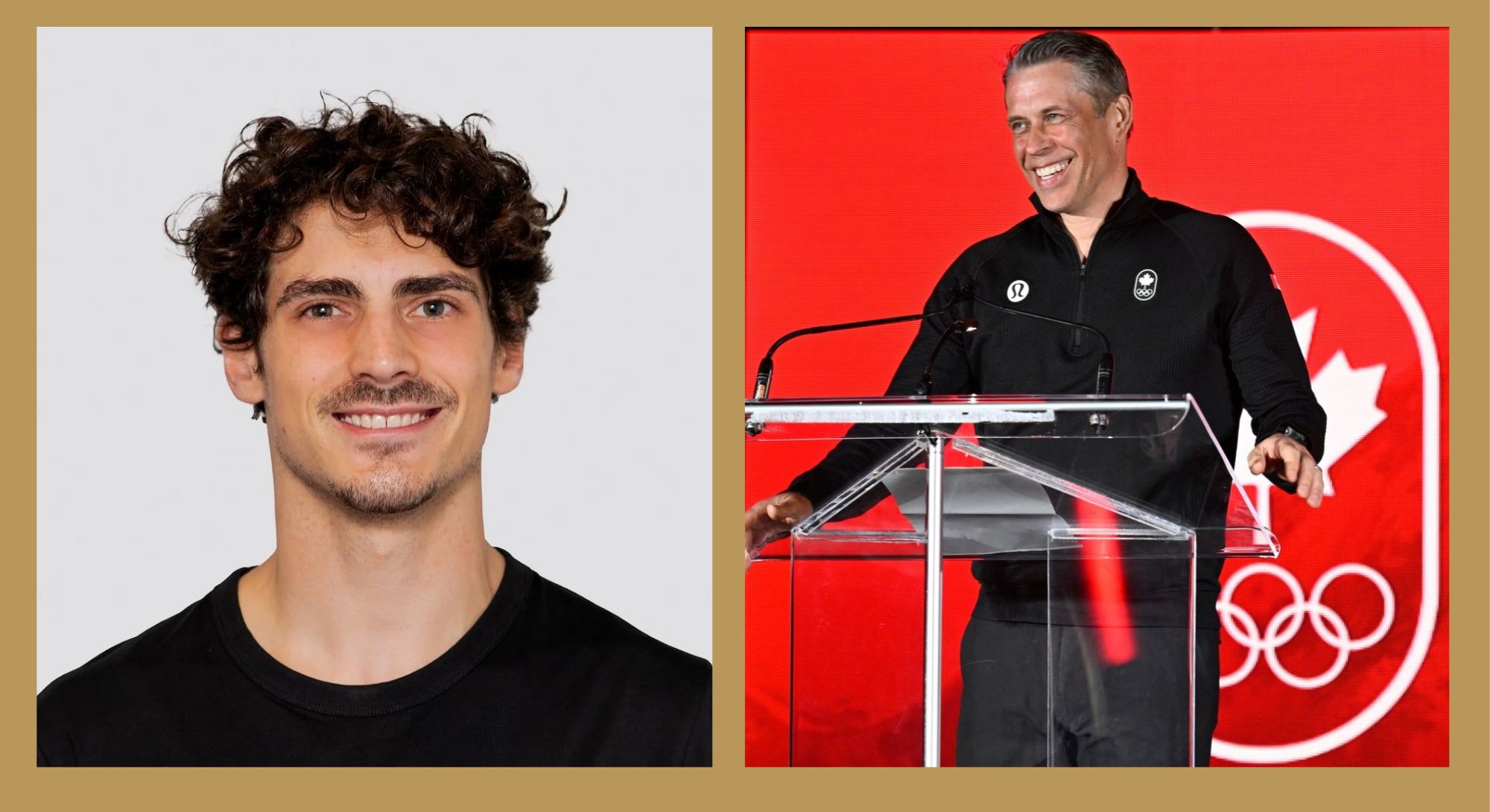
Ice dancer Paul Poirier ’15 competed in his first Olympic Games, Vancouver 2010, before his first day at Trinity. Sixteen years later, at his fourth Games, he and his partner, Piper Gilles, won bronze at Milano Cortina 2026 — then took silver at the World Championships.
David Shoemaker ’92 reached the Olympic movement by a very different road: a Supreme Court of Canada clerkship, the presidency of the Women’s Tennis Association, and the leadership of NBA China. Today, as CEO and Secretary General of the Canadian Olympic Committee, he leads the organization responsible for Team Canada.

The two had already discovered their Trinity connection on their own. In October 2026, Trinity brought them together for a conversation that ran from Strachan Hall to the Olympic stage.
Who were you at Trinity, and what did you imagine your life was going to look like?
DS: Trinity was a long time ago for me, and I don’t think in my wildest dreams I could have imagined the career I’ve had. I lived in residence, and I made lifelong friends. Academics were important, but it was life outside the classroom that was so valuable — in Strachan Hall, watching late-night television, debate nights.
PP: Skating is a very early-specialization sport, so I entered university already an Olympian. I started at Trinity thinking, I’m going to do my undergrad, keep training, go to the Olympics in Sochi and win my medal, and then move on. [Poirier did not make the 2014 Olympic team due to injury.] Twelve years later, I’m still competing, and my experience as an athlete has been so much richer than I could have imagined.
Paul, was Trinity one of the few places where you weren’t “Paul Poirier, Olympian”?
PP: It was a little of both. People knew who I was, and I didn’t necessarily know who they were. But as I made friends, I built relationships completely outside of sport, where I just got to be a human. I didn’t live on campus, and I trained in the mornings, so to avoid going home at rush hour after class, I’d escape to Strachan Hall or study at the Buttery. I made friends during those years who are still with me today. School was a way for me to shed my athlete skin and let my brain work on something else. That was a gift.
What did each of you misunderstand about elite sport before you saw it from the inside?
DS: People assume the life of an Olympian is glamorous and financially rewarding. [Poirier laughs.] When we visited Chula Vista, California [where Canada’s summer Olympic athletes hold training camps], we realized it’s like living in college: a dorm room with roommates, a cafeteria where the sport of the day is complaining about the food, and hours of training with no one there to see it. Those hours are what pay off on the grand stage, and that’s not well understood. I didn’t fully understand it coming into the role.
PP: I absolutely agree. I went into sport naively believing that showing up and working hard would be sufficient. At a high level, that’s the baseline: everybody’s talented, everybody works hard. So much more comes down to very small decisions — changing a supplement, the timing of your meals — that can have very large impacts. You have to try things to tweak your training and your routine without knowing what will work. Everything is risky. Everything comes with a cost. The stakes are so high, and you have to sit with that all the time. And there’s a lot of discomfort that comes with being an athlete, so you’re always gauging: is this discomfort telling me to stop, or discomfort I need to push through? It takes years to build the wisdom to know the difference, and that’s ultimately what separates champions from those who get very close.
Canadian sport has spent the past few years confronting serious questions about athlete safety. What should we never be willing to sacrifice in pursuit of excellence?
PP: Health and safety, first and foremost. Sport comes with inherent risk, but if we have clear information that something will put an athlete in danger, that’s not something we should proceed with.
DS: I agree with Paul completely. We believe you can walk and chew gum at the same time: you can be fully committed to excellence and fully committed to what we call safe sport. It used to be that if you’d been mistreated, you’d have to complain to the very person or place you believed was responsible. How comfortable would you feel doing that? We’ve now invested in independent places for athletes to report maltreatment without fear of retribution. That probably should have happened decades ago, but what matters is we have the Safe Sport framework now.
Complete this sentence: The Olympics matter because …
DS: They matter more now than they ever have. It’s one of the few places left on Earth, including the United Nations, where 206 nations come together, live together, eat together, and compete together, and when the competition is over, they shake hands. They inspire young Canadians to live a life of sport. Maybe they’ll become Paul Poirier — they probably won’t — but they’ll learn to be more resilient, better communicators, better leaders, and better teammates. You learn to win, and you learn how to lose.
PP: The Olympics give us a small glimpse of the totality of human experience: hardship, hard work, triumph, happiness, sadness, anger, resilience, all in one very small package. These athletes have given so much of their time and heart to one task — a trivial task, in a way, but they make it their everything — and to see that distilled in a moment is one of the most remarkable and beautiful things. We can all be inspired by their stories, by the paths they’ve taken to get there.
DS: And it’s nation building. How many moments in our country’s history do we mark with “where were you when”? Sidney Crosby’s golden goal in Vancouver in 2010. Our men’s 4×100-metre relay team winning gold in Paris in 2024. These moments unite our country like nothing else. There’s something more than just sport riding on sporting events — it becomes part of our national psyche, how we feel about ourselves as a country — and provided we don’t get carried away, I think it’s beautiful.
Imagine we’re having this conversation at Trinity with a group of 20-year-olds. What would you want them to understand that you didn’t at their age?
DS: There’s no single recipe. My advice is to get the best broad-based experience you can, and your drive to work in one area, let’s say, sport will eventually rise to the top. Getting the best experiences I could — and that includes going to a school like Trinity College — gave me the capability to do what I do today.
PP: The biggest lesson I’ve learned is not to be so tied to your own plans for your life. So many wonderful opportunities have come to me that I never pictured, and I had to be open to them. I thought I was going to gain success quickly and retire very young. The pinnacle we reach is not always the one we set out for at the start.
Paul Poirier ’15 is an ice dancer, six-time Canadian national champion, and four-time Olympian. At Trinity, he earned a BA in linguistics; he later completed an MA at U of T. With partner Piper Gilles, he competed at PyeongChang 2018 and Beijing 2022, and won Olympic bronze at Milano Cortina 2026.
David Shoemaker ’90 studied political science at Trinity and law at Western University. He clerked for Chief Justice Antonio Lamer of the Supreme Court of Canada, practised sports law in New York, served as president of the Women’s Tennis Association, and led NBA China before becoming CEO and Secretary General of the Canadian Olympic Committee in 2019.


Title Image Credits:
Paul Poirier’s headshot provided courtesy of Canadian Olympic Committee.
David Shoemaker, COC CEO, speaking in Montreal, 2025. Photo by Bernard Brault/COC
– by Jennifer Matthews