Introducing Ask the Archivist, a new column in which Rolph-Bell Archivist Lindsay Grant answers questions about the Trinity College Archives: what it holds, who uses it, and the stories its collections tell. Throughout this175th anniversary year, each column connects to one of the featured themes.
Have a question for the Archivist? Send it to trinity.archives@utoronto.ca
“What do you have here?”
by Lindsay Grant, Rolph-Bell Archivist

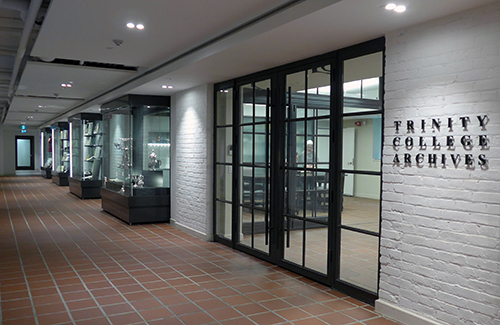
Students often wander down to the lower level of 6 Hoskin Avenue during their first weeks at school. Sometimes they are looking for the laundry room or mail room. Other times they are drawn in by the Archives’ gallery space and exhibit cases, filled with treasures like Trinity blazers, historic photographs, archival documents, and of course, the glittering College silver. A few are simply curious about our bright, inviting reading room.
I often wonder what students make of the space when they first arrive. The exhibit cases, the shelves lined with books, the artifacts and photographs: it looks a little like a library and a little like a museum, yet it is neither. For many students, it is their first encounter with an archive. And after they summon the courage (or succumb to their curiosity) to step through the door, the first question is often: “What do you have here?”
The literal answer is that the Archives preserves the records of Trinity College and the people who have shaped its history: provosts, professors, administrators, alumni, student groups, and many others. Our holdings include those records, along with student publications dating back to the 1880s, more than 5,000 photographs, more than 3,000 architectural drawings, and research collections that support Trinity’s academic programs. Among them are papers of diplomats, ambassadors, politicians, and others involved in Canadian foreign relations.
Sometimes I answer the question differently. What we have here is the institutional memory of Trinity College.
Sometimes I answer students’ question differently. What we have in the Archives is the institutional memory of Trinity College.
We have the records that help us understand how Trinity came to be, including our Royal Charter of 1852. They document the decisions that shaped the College, the courses that were taught, the students who attended, and the communities that formed here. They show Trinity’s beginnings on Queen Street West, in what is now Trinity Bellwoods Park, quite separate from the city and the University of Toronto, but also its move to federation, and then to Queen’s Park, and the many changes that followed.
The Archives preserves not only the voices of leaders and administrators, but also those of alumni, students, and their clubs and organizations. Through these records, we can trace athletic competitions, theatre productions, celebrations, meals, friendships, and even the clubs that were founded on the slenderest of premises (the James Bond Society, anyone?), providing students with reasons to gather, socialize, and create their own traditions.
Some records connect Trinity directly to larger moments in Canadian history. Among them is a letter from Isaac Brock appointing John Strachan Rector of York in July 1812, just weeks after the outbreak of the War of 1812. The appointment marked a significant moment in Strachan’s rise to power, and helped solidify his position as one of the most influential figures in the political, educational, and religious life of early Upper Canada.
Other records reveal how Trinity helped shape the world. We can see this through the papers of alumni such as George Ignatieff ’36, Blair Seaborn ’45, John Hadwen ’48, and Michael Shenstone ’49, whose careers in diplomacy and international affairs placed them at the centre of some of the most significant political developments of the 20th century.
These stories are not just preserved on paper. They live in photographs, scrapbooks, sound recordings, films, posters, artworks, and textiles. Through these artifacts, we can glimpse not only what happened, but also what it looked and sounded like to be a part of Trinity. We can browse through images of Conversat or Convocation. We can examine well-worn gowns and treasured blazers. We can hear the Chapel Choir singing at Evensong, or Margaret MacMillan delivering a lecture to a rapt audience. And tucked away in an artifacts box, we even have an adorable little egg cup that was once spirited away from the St. Hilda’s dining hall.
Ultimately, what we have here is more than a collection of documents and artifacts. We have Trinity’s story, told from many perspectives, and across many generations. Sometimes the story is frustratingly incomplete; other times it survives in remarkable detail. But it is here for anyone who wants to explore it.

If you’d like to see some of the story for yourself, Trinity at 175: A Tradition of Excellence is on display in the Archives on the lower level of 6 Hoskin Avenue through fall 2027. Co-curated with students, alumni, and staff, it tells the story of Trinity’s traditions through objects from our collections.