By the John W. Graham Library and Trinity College Archives
There is no shortage of spine-chilling discoveries in the Trinity College Archives. Here, we highlight two skeletons, and debate the existence of ghosts!
One expects to find at least a few strange, unusual, or even macabre things in the Archives. After all, we are responsible for preserving Trinity’s history, including some of its more chilling chapters.
One such curious case emerged in the 1920s, when a human skeleton was uncovered in the basement of a former Trinity freshman residence on Queen Street West known as “Jag House.” Much of what we know about the discovery comes from newspaper clippings preserved in a student scrapbook now held in the Archives. The residence building had a long and varied history. It once housed students of the Trinity Medical College in the 1880s, and later served as a Keeley Institute, a treatment centre for alcohol addiction. It eventually became a Trinity student residence before the move the Queen’s Park.
The skeleton came to light during the demolition of the building, and it prompted a police investigation. Police found few clues. No clothing, personal effects, or identifying items accompanied the remains. In the absence of evidence, theories flourished. Some speculated that the skeleton was connected to the former medical college, while others wondered whether it might be linked to the Keeley Institute. Rumours had long circulated among Trinity students that a skeleton was hidden somewhere in the house.

A clipping about the discovery of the skeleton in a student scrapbook. F2306 Scrapbook Collection, Student Scrapbook 1926-1930, Box 11.
The investigation even touched on one of Canada’s most intriguing unsolved mysteries: the 1919 disappearance of theatre magnate Ambrose Small. That theory was quickly extinguished when the coroner noted that the skeleton lacked Small’s distinctive gold-capped teeth. But the coroner did observe a small red mark on the right side of the skull, and concluded that the remains were likely those of a teaching or lab specimen, rather than the victim of a crime. That assessment lent credibility to a long-standing student tale that the skeleton was a relic of the old Trinity Medical College. According to the story, a don once returned to his room late at night to find the skeleton sitting in front of the fireplace, placed there by mischievous students.

An explanation is offered for the presence of the skeleton in an article from The Varsity. F2306 Scrapbook Collection, Student Scrapbook 1926-1930, Box 11.
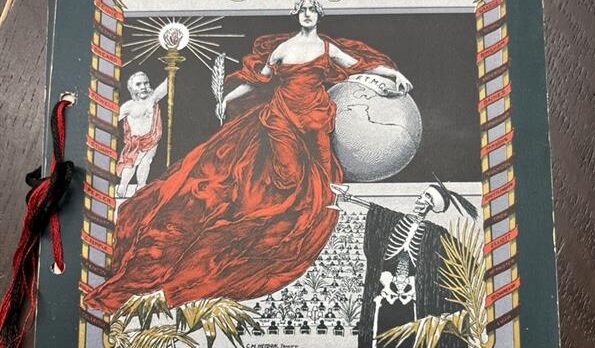
The Jag House “relic” was not the only skeleton associated with Trinity Medical College. In fact, the College seems to have had a fondness for skeletal imagery, as evidenced by this jolly skeleton with a martini glass that appeared on the programme for its annual banquet in 1901.He shares the spotlight with a laurel-crowned woman in a flowing red gown and a mutton-chopped torchbearer. Whatever the symbolism here, it looks like this banquet was the party to be at. And this is admittedly one of our favourite little skeletons in the Archives.

Programme for the Annual Banquet of the Trinity Medical College, 1901. F1018 Trinity Medical College Fonds, Box 8, File 1.
Our final story concerns not a skeleton, but something more … formless. According to an article preserved in a student scrapbook, in November of 1928, the Trinity College Literary Institute had a spirited debate about the existence of ghosts. At the conclusion of the evening, the house resolved by a margin of 18 to 13 that ghosts do indeed exist. The opposition put forward a compelling case, arguing that ghosts were merely a product of upset digestive systems. But the government’s argument in favour of a “subjective scientific ghost” ultimately proved stronger (though it was admitted that an “objective” ghost would be harder to defend).

“This house believes in ghosts” declares the Lit, according to an article in The Varsity. F2306 Scrapbook Collection, Student Scrapbook 1926-1930, Box 11.
More than a century later, we might like to see this debate staged again. Perhaps in the dark of night, and in a historic College building? Just in case anyone, or anything, is listening!