By Sharon Reid, Margaret MacMillan Trinity One Program Coordinator
On a small, 100-acre farm in Creemore, The New Farm Centre‘s founders Brent Preston and Gillian Flies are demonstrating that regenerative agriculture can be both ecologically and economically advantageous, offering farmers and policymakers a viable alternative to the harmful effects of large-scale industrial farming.


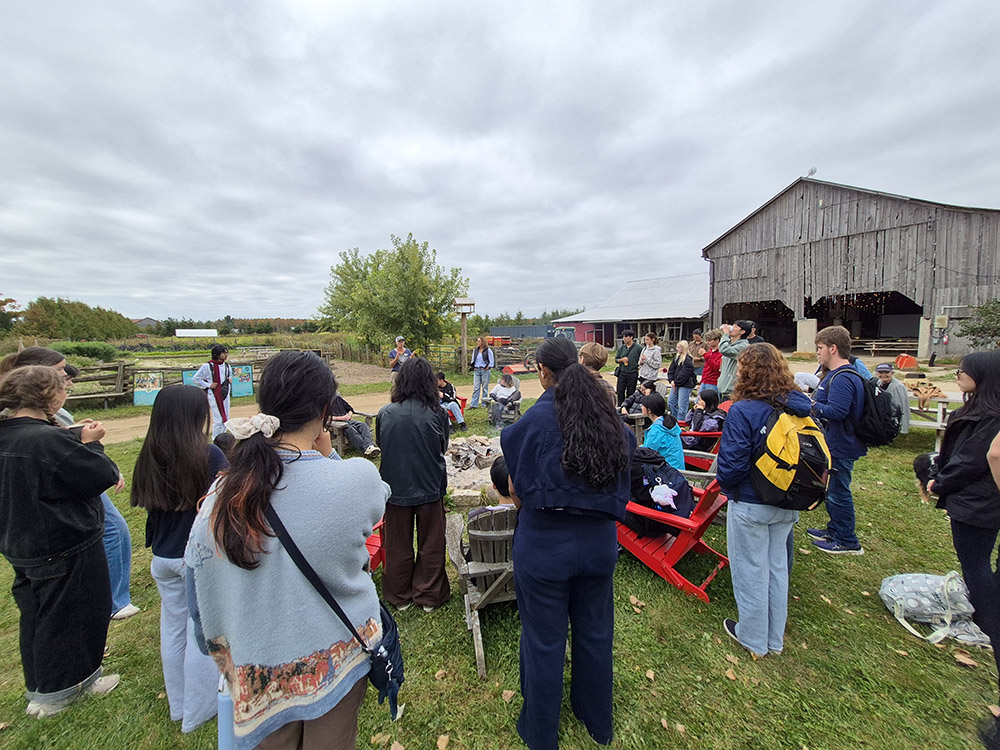
On September 29, 2026, The New Farm Centre welcomed students and faculty from the Margaret MacMillan Trinity One Program to their farm for a day of hope, education and hands-on learning. This year, students from the Butterfield Environment & Sustainability and Ethics, Society & Law streams were joined by donors Martha and George Butterfield, and Joannah and Brian Lawson, who provided a generous $10 million gift to launch Trinity’s Integrated Sustainability Initiative. The group spent the day immersed in farming practices that show how small changes can have a significant impact on climate change, soil health and food production.
The day began with an introduction to regenerative agriculture. For those unfamiliar with the concept, Brent outlined the five pillars of the farm’s approach: minimizing soil disturbance, reducing fertilizer use, building biodiversity, integrating livestock, and maintaining living roots year-round. Even farmers who remain skeptical about climate change are often persuaded by the economic benefits of these practices. Brent explained how reducing reliance on expensive pesticides and fossil fuel-based fertilizers in favour of cover crops, animal integration, and composting can improve soil health, increase water retention, and reduce operating costs.
The first stop on the tour was a field of market lettuce, protected by low hoop nets that prevent insect damage and eliminate the need for pesticides. Beside it grew a diverse mix of cover crops, including turnips, clover, triticale and other species that serve as livestock feed, and to capture carbon and enrich the soil. Here, hands-on learning began. New Farm staff member Sanna Huyssen and Brent invited students into the field to identify plants and insects. The groups filled trays with specimens, some collecting as many as 20 different varieties, which Brent and Sanna then helped identify.
Next came examples of livestock integration. Mobile chicken coops protected the birds from predators while allowing them to move through the pastures, feeding on cover crops and contributing manure that would later enrich the compost. Nearby, a herd of cattle, complete with calves, grazed the fields and naturally replenished soil nutrients. In the woods, pigs contributed to the farm’s silvopasture system while enjoying the shade. As they foraged, their powerful snouts aerated and turned the soil. Like all of the farm’s livestock, the pigs were moved regularly to prevent overgrazing and minimize soil disturbance.
Back near the farmhouse, students toured large greenhouses filled with cucumbers, tomatoes and cover crops. Once again, the value of biodiversity was evident. Even in late September, the harvest was varied, abundant and delicious. Signs posted outside the greenhouses described the ongoing experiments taking place on the farm, highlighting its commitment to testing and refining sustainable practices.
At the end of the row of greenhouses, students met the farm’s Kunekune pigs, a New Zealand breed known for its gentle disposition. Staff invited students into the enclosure with these friendly grazers. For many, it was a first experience interacting with livestock, and the Kunekune pigs did not disappoint as they happily accepted apples and enjoyed a good scratch behind the ears.
The day concluded with a lunch of fresh, made-to-order pizza cooked in large outdoor ovens and accompanied by seasonal salad greens. The New Farm Centre is an organically certified producer that supplies high-quality food to leading restaurants.
As a final treat, Sanna guided students through one last experiment demonstrating the effect of soil management on water retention. Four samples were lined up: recently tilled bare soil from a neighbouring farm, soil from the New Farm lettuce garden, soil from a cover-cropped field, and soil from a pasture that had never been cultivated. Four students poured pitchers of water onto the samples simultaneously, allowing the group to observe how quickly water moved through each type of soil. The striking difference in water retention demonstrated the value of maintaining living roots throughout the year.
New Farm is an example of science in action and offers a persuasive, hopeful vision of how regenerative agriculture can contribute to the fight against climate change. Trinity One is fortunate to visit this place of innovation and optimism, where students can witness practical alternatives to conventional farming, learn about economically viable and scalable solutions, and participate in a culture of experimentation that continues to generate new ideas for the future.