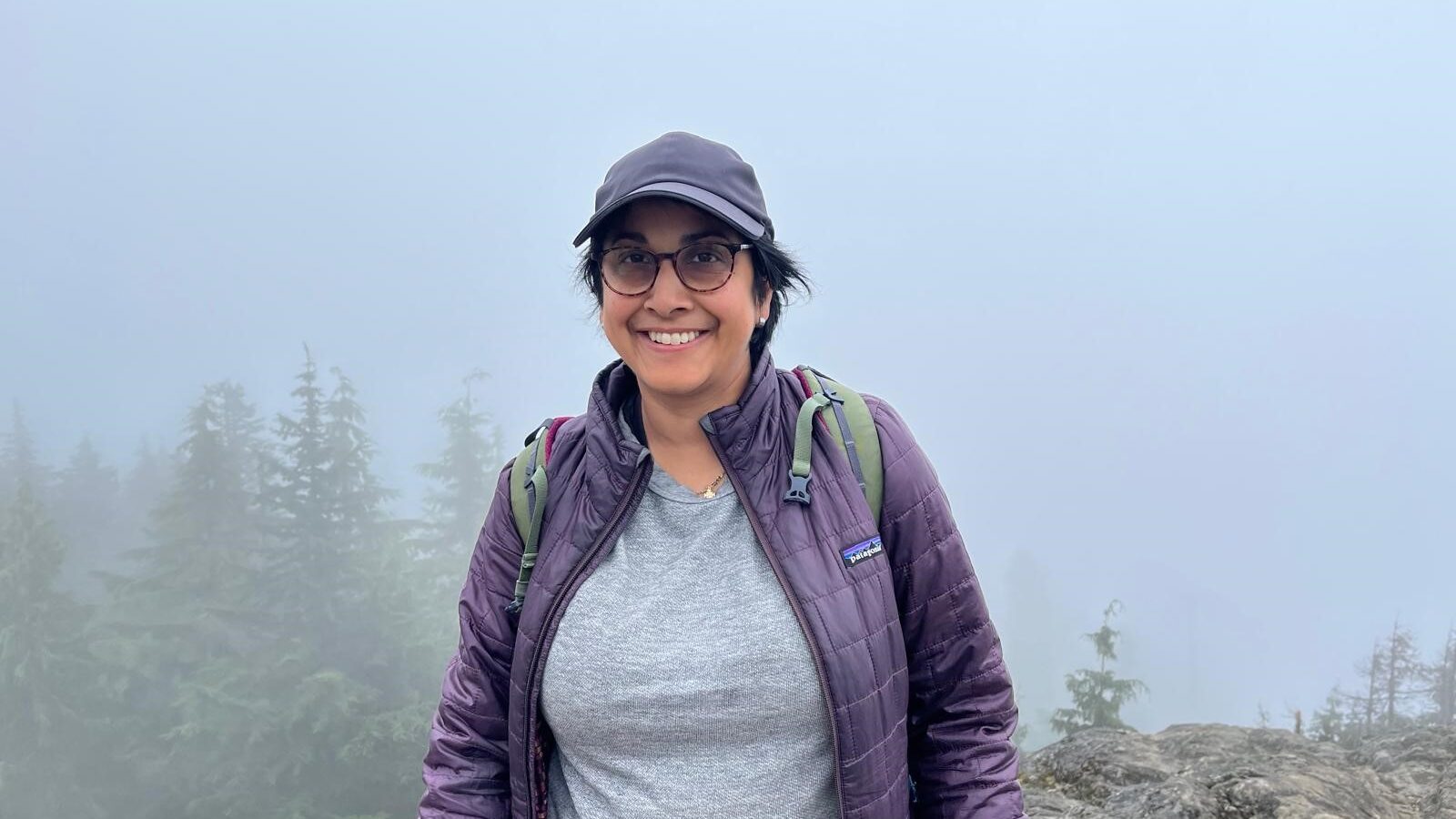
The Rev. Areeta Bridgemohan MDiv ’15 is born in Guyana, grew up in Rome, lived in the US and has settled in Vancouver – for now. Not a cradle Anglican, but always focused on a life of service, Areeta came to ministry after a career in global health and community development. Read about her journey and her memories from her time at Trinity.

1. Since graduating from Trinity in 2015 you were ordained in the U.S. Episcopal Church and have served in Michigan and Virginia. You’re currently serving as Vicar at Christ Church Cathedral in Vancouver. Can you tell us a bit about that journey?
During my time at Trinity, I was canonically resident in the Diocese of Michigan. I felt well supported in my discernment journey by the Diocese, and particularly by my Bishop. Towards the end of my time at Trinity I felt a clear sense of call to begin my ordained ministry in Michigan. My curacy at Christ Church Grosse Pointe was a place of intense learning and growth. Towards the end of my curacy, it became clear that I would need to find another call. With the support of the Canon to the Ordinary in the Diocese, I explored many calls in many places across the Midwest and East Coast of the United States.
At the time, I was dating my soon-to-be spouse. He wanted to return to the Washington D.C. area to serve in the federal government. I wanted to explore public theology and social justice in the context of ordained ministry. In the end, the Spirit opened the doors to a call in Virginia, in a small town called Fredericksburg.
St. George’s is a large church in a small town. In true form to the unfolding of my journey, the Spirit shaped my call in a way totally different from the way I had envisioned it. I experienced ministry in a ‘purple’ church. I experienced a large, vibrant church with diverse worship styles and active lay leadership with many children, youth and families of young children in a wider culture that still places significant value on church involvement.
My experience of the pandemic was greatly shaped by giving birth to my first child 4 months after lockdown. My experience of becoming a mother in the United States radically changed the way I experienced the health care system, norms around work, political rhetoric and gun culture. What felt abstract, or at least manageable, began to feel heavy and toxic.
All of this, and the emerging desire to have another child, made the intention to move to Canada our next natural move. As per the Spirit’s plan (not mine), I ended up in Vancouver; our first time living on the West Coast. It was a really hard move, right in the middle of my second pregnancy. I returned to a different Canada. It’s taken quite some time, as well as a lot of support from my colleagues at the Cathedral and within the Diocese, friends both here and abroad, and family to finally start feeling like we’ve got our feet back under us, and a sense of home again.
2. As well as your MDiv you have degrees in public health and international development and you have worked in public health and community development in Canada, Barbados and Guyana. Can you tell us a little about that work and how it might have led to a call to ordained ministry?
I came across the newly elected Archbishop of Canterbury’s description of her journey from nurse and public servant to ordained ministry. When asked about her two careers, she said, “I prefer to think that I have always had one vocation: to follow Jesus Christ.”.[1] This sentiment resonates with me and mirrors what has motivated my work throughout my career, in international development, community development and ordained ministry. It was a sense of sacred call that led me to pursue a career in global health; it was a way I felt I could be most helpful to God and the world. I loved the work and I learned so much about equity, systems, partnership and listening, all of which shape the way I approach ministry.
3. What’s a typical day for you as Vicar? What’s your favourite thing about this post? What are some of the challenges?
On a typical Sunday, I arrive about 2 hours prior to the main service, help troubleshoot issues for children’s ministry, worship, and connect with colleagues, members and visitors. We often have an adult education hour that I support. We then gather before the service with the choir, the servers and clergy and pray. After worship, I pop down to coffee hour and then co-lead a drop-in informal weekly group where we bring our lunches and discuss a topic related to our faith community.
On a typical weekday, I write emails for Jesus; organizing and planning ministry events and groups, connecting with colleagues about programs. I preside at a midweek Eucharist, attend a weekly staff meeting, do pastoral visiting either at the Cathedral or in hospitals/long-term care facilities/rehabs/homes.
My favourite thing about this position is the variety. The variety of people, ministry areas, places that I get to learn about and support. I am particularly excited about the emergence of leading contemplative offerings at the Cathedral, a thread of its multi-faceted identity. I love the ability to be creative in my ministry. The Cathedral is a diverse, intellectually curious, community that is in touch with its spiritual thirst and the value of our faith and spirituality to the world’s suffering.
The main challenge of the position is the variety. There are more needs than capacity to meet them and I sometimes get overwhelmed. I wonder how to step out of the busy work and lean into creativity without feeling like I’m neglecting something. When I walk by the square in front of the Vancouver Art Gallery, around the corner from the Cathedral, I wonder what we could bring if we shared the beauty and talent we have in our community with the wider community. Could we lay down our large canvas labyrinth there and play music and invite people to walk there? Could we do memorials for people who have died on the streets or due to toxic drugs there? Could we have our Lessons and Carols from around the World service outside by the giant Christmas tree they light up and put in the square?
Another challenge of the diversity of the community is how to make it feel more cohesive. How do we help people feel like they belong, whether they are from unchurched backgrounds, speak English as a fourth language, or were brought up in predominantly Muslim countries? Community building with the people coming through our doors, and also with those not stepping through our doors – like the Indigenous groups on whose land we worship?
4. Tell us about some of your favourite memories of your time at Trinity. What’s stayed with you?
To be honest, I felt like a fish out of water for my first 4 years at Trinity (I did my MDiv over a period of 6 years). I am not a cradle Anglican, and while I have come to appreciate Trinity’s liturgical tradition, the culture around liturgy felt quite disorienting and scary for much of my time. Towards the end of my time at Trinity, when I was registered as a full-time student, I began to make friends with fellow students. These relationships helped me overcome my feelings of inadequacy and helped me feel more at home. I was able to ask questions of my peers I didn’t feel comfortable asking in more formal settings. As I learned about the Oxford Movement, I came to see the beauty of the intention behind it. This journey has helped me to be a conversation partner with those in the communities I serve who find Anglo-Catholic expressions of worship problematic or alienating.
I felt a great deal of loneliness in my first 4 years at Trinity, which was also due to events taking place in my personal life. This prolonged period of loneliness was an important experience for me. It invited me to turn inward. It helped me find healing in small gestures of kindness and warmth. It was fertile ground for “self-differentiation”, as Friedman and others would say. It gave rise to growth that was necessary for me to be able to claim my call to ordination and has been essential in ministry.
The trip to the Holy Land during my studies was a highlight and Trinity’s generosity in supporting students to be able to take that trip was such a gift. Again, were it not for fellow Trinity students encouraging me to go, I would have missed out on a formational experience in my faith. Especially in light of the tragedy that continues to unfold.
5. What feeds you? Is there something in your spare time or any new projects in your ministry or studies that you’d like to share with us?
In my current season of life, with a full-time job and two small children (aged 2 and 5) and a dog (!), spare time isn’t something I often experience! My family is a source of nourishment for my mind, soul and body (when we’re not driving each other crazy!).
Since returning to Canada, my reading often includes authors of Indigenous backgrounds. I am quietly seeking to educate myself, to grow in my understanding of Indigenous history, perspectives and wisdom. Not so much in an academically rigorous way, but a heart-led way.
My reading also often includes learning about the Sabbath. My family has started to practice a digital Sabbath which I find immensely restorative. It allows me to focus on the kids and what we’re doing, allowing me to release some of the mental load that I carry. I love the beauty and accessibility of the natural world in this part of the country. We go on hikes, bike rides, and walks along the estuary of the Fraser River (where we live).
In my ministry, there are two projects I am in the initial phases of thinking about. One is to continue to work on building a community around the thread of contemplative practice that is part of this Cathedral’s identity, and having it intersect with eco-anxiety and grief, social issues that feel unsolvable, as well as building spiritual community. The other is to draw on the parish nursing model with a focus on psychiatric care, possibly as a shared resource with a nearby downtown church. Stay tuned!
[1] Email sent on Oct 3, 2025: “Presiding Bishop Sean Rowe congratulates new Archbishop of Canterbury” 2025 The Domestic & Foreign Missionary Society.