Second Place: Friends of the Library 50th Anniversary Short Story Contest
by Gabriel Rodin Lozada
The sun lit the gardens like a Grecian idyll, painting the humble collegiate vista with all the colours of Arcadia. From his vantage behind the third floor window the scene unfolded beneath him. Geese wandering to and fro in little clusters of feather and rancour, home after a warm and rainy winter. Other students lounging in the sun smoking cigarettes, pretending they couldn’t read the signs prohibiting their favourite vice. A tour group shuffling through the wrought iron gate just then, still bright eyed and bushy tailed. They were not much younger than him, but even from afar they looked like children — replete with all the acne, angst and looming dread he had known all too well four years ago. Some of them were coming home for the first time and they didn’t even know it.
“Sic transit gloria mundi.” He murmured under his breath, turning back to his laptop screen and pretending to read Hegel. Paradoxically, as the final days of his undergraduate degree crept ever closer the banal everyday tasks of a student seemed more and more impossible. There was a thesis paper and a whole menagerie of exams and culminating assignments to wade through before graduation, but here at the boundary between university and some nebulous adulthood his schoolwork had mostly faded from his awareness. Trying to read he felt himself looking through the screen more than at it, the blocks of text flickering past his eyes completely undigested. Infinity is a circle, not a straight line — that was pretty much all he could glean, and who could say what that meant?
Standing up, he shuffled away from the window and towards the cushioned chairs by the old bust of Lampman. If he was only going to pretend to study then he at least wanted to be comfortable. Sitting half-horizontally, he shimmied out of his shoes and put his feet up on the low coffee table before him, setting his laptop open on his extended legs. Back to the scroll, back to the circular infinities.
The room felt as though it was pressing in on him. The library was always slow to turn off the heat, even when summer was nearly arrived. On every side the air was thick and warm, blanketing every part of him in its embrace. The effort required to stare at his screen, even though he was not really reading, seemed suddenly to multiply a thousandfold. Soon enough it was a challenge to keep even slightly upright.
“Infinity is a circle…” He murmured as the last grain of willpower crumbled within him and he let his eyes close just for a little while.
He wasn’t sleeping, nor was he awake. Again he found himself somewhere in the hazy middle ground. Finishing school but not quite finished, no longer a boy but so very far from a man, not conscious but not quite dreaming either.
His eyes were open despite the fact he had not opened them, and though he weakly attempted to force them shut he could not. So too did his head turn, propelled by some unconscious muscle instinct which was very suddenly out of his power. Slowly his vision panned back and forth across the room, the brown panelling of the walls and shelves swimming before his eyes until they finally settled on the white marble bust.
Archibald Lampman, the Canadian Keats, appeared to stare down at him. The white lips seemed to move in their own inimitable way, a grimacing or perhaps smirking, and the pupil-less stone eyes somehow gave the sense that they were regarding him. It was as if the bust was suddenly possessed by some errant ghost or poltergeist, perhaps even that of the poet himself — but of course it was matter of school policy that there were no ghosts at Trinity College.
Still, in that spectral stony gaze he could feel a very real judgment. Those unblinking eyes peaking over that steep nose and dignified Victorian moustache contained within the crushing verdict of the centuries. Then the marble lips parted, and the statue spoke as once the man had spoke more than a century before;
Beside the pounding cataracts
Of midnight streams unknown to us
‘Tis builded in the leafless tracts
And valleys huge of Tartarus.
Lurid and lofty and vast it seems;
It hath no rounded name that rings,
But I have heard it called in dreams
The City of the End of Things.
His eyes finally, mercifully closed and he fell deeper into the grip of sleep. Of course, he dreamed of circles.
The passing of the seasons; spring, then summer, then fall, then winter, then spring, then summer, then fall, then winter again, a little warmer every time. Construction; roads paved then cracked then paved anew. Bike lanes erected and then torn down and then built back up again. The new students funnelled through the garden gate, lingering a little amid the sun and the trees before shuffling off into an uncertain future with a new generation nipping at their heels.
Everywhere the circles closed off, tighter and tighter, short-circuiting until they vanished into nothing and the city came into sight — iron towers sprouting up in the night, the now-ancient facades of libraries and archives bulging with the knowledge of a world passed, great machines of iron and flame spinning down the streets in gigantic harmony. No man walked here, no human foot tread the paved Earth. The last survivors of the city’s prodigious race clustered in the tallest and greatest of the iron towers, numbered three, growing older and older, their spindly fingers working the terrible machinery of the city with ever diminishing grace.
At the gate of the city sat a soulless mindless mass of flesh, a man so pale he was almost the colour of the bust, and with his lightless eyes he regarded the faltering city and he wondered how man could’ve ever built such a thing. He gazed at the colossal towers and could not imagine how they had come to stand so tall. He gazed upon the long perfect streets and was baffled that they had been made so straight and flat. He gazed upon the grand libraries and archives and mausoleums and he could not fathom the glory of the world which laid buried therein. And seeing all the wonders of a world which was not his own, fading as a dream fades, as the best days of one’s life fade little by little until it is difficult to remember them at all, he wept, and his weeping echoed down the abandoned streets. He wept, for he saw a world that had run its course, a world immortalized in marble which he could never hope to join.
The final circle closed off, and the dream ended.
He woke in a cold sweat, the dead screen of his laptop mirroring his uneasy eyes back at him. Shutting it quickly, he laid the hunk of metal and wires on the coffee table and began to nervously pace the room, making every effort to avoid the judgmental gaze of Lampman’s bust. His mind raced to interpret the dream, but as is the case with many dreams its meaning was perhaps too obvious to be interesting. He too wanted to be a poet, to be immortalized here in marble, to stand watchful over the coming generations his dignified image a reminder of the greatness they were to aspire to. But of course he was no Lampman, and there was no room today for men to become statues. There were theses to write, and after that a job to find (with a philosophy degree no less!) and rent to pay and a thousand more banalities. This was already the city at the end of things, and he was already the idiot at the gate, condemned to look upon the works of greater men and despair.
Finding himself again at the window, he looked again over the garden as twilight slowly sank the city into night. The students and the tour groups and the geese had gone now, leaving only a solitary figure looming at the gate. Slim and of middling height, the man wore a gown in the fashion of the old days, and he held in his hand a long pipe of the sort that one imagines an old Victorian gentleman might smoke. With no little astonishment, he realized that the man at the gate had precisely the same dignified bearing as the bust, though his eyes were not stone, for he wept the all too human tears of a man looking back not on the wonders of a past world, but the simple pleasures of a past life.
And so there at the gate Lampman wept and puffed on his pipe, and up in the window the student smiled at the thought that whatever may come the circle of infinity might return some trace of him to this very spot, to the place he and the poet had shared.

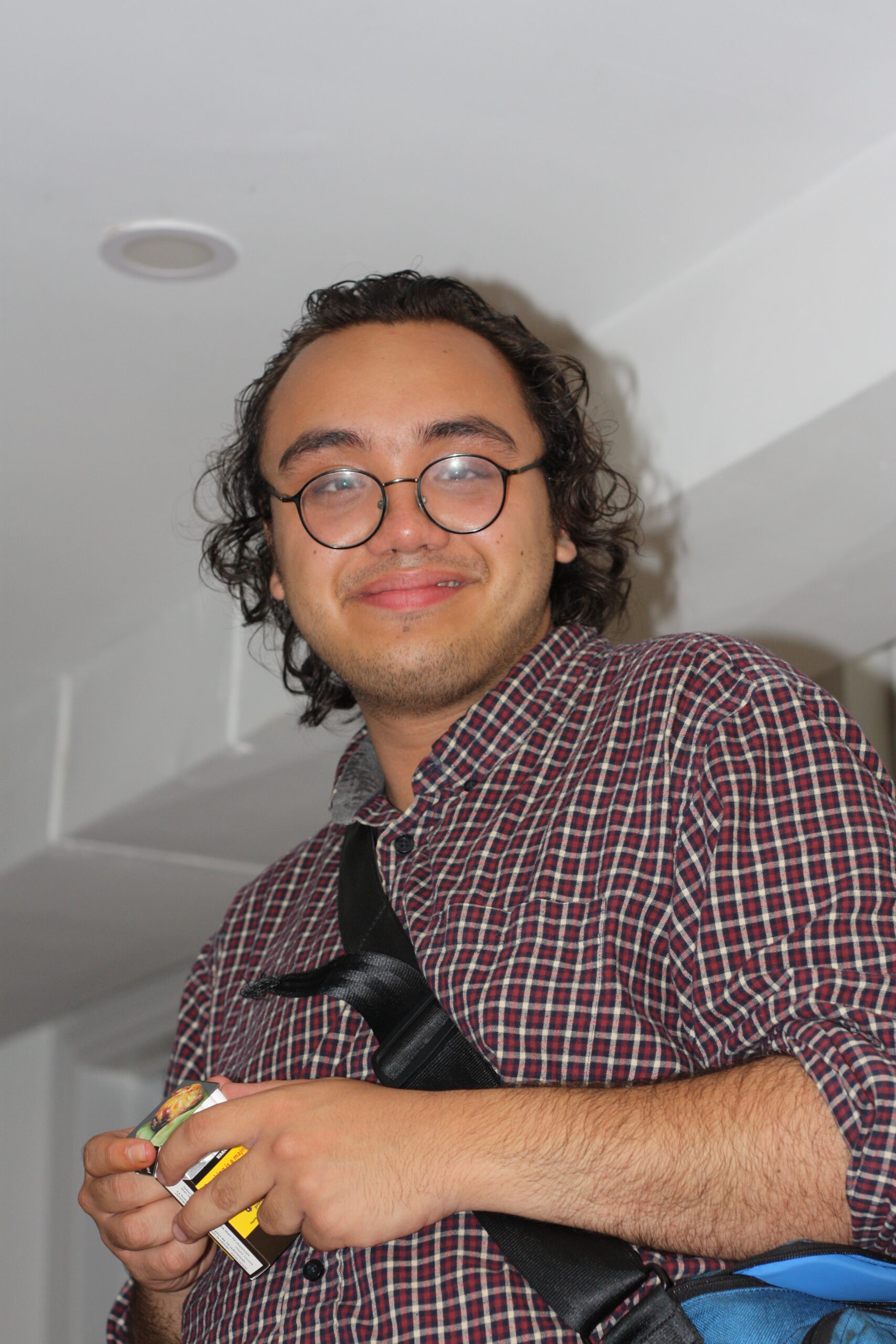
Gabriel Rodin Lozada is a recent graduate from Trinity College at the University of Toronto, currently living in Toronto. Presently on a break from school, he will (hopefully) return to pursue a masters degree in anthropology. While not occupied with his day job, Gabriel keeps himself busy with writing in the hopes that he will one day be able to make a career for himself as a novelist.