By Jennifer Matthews

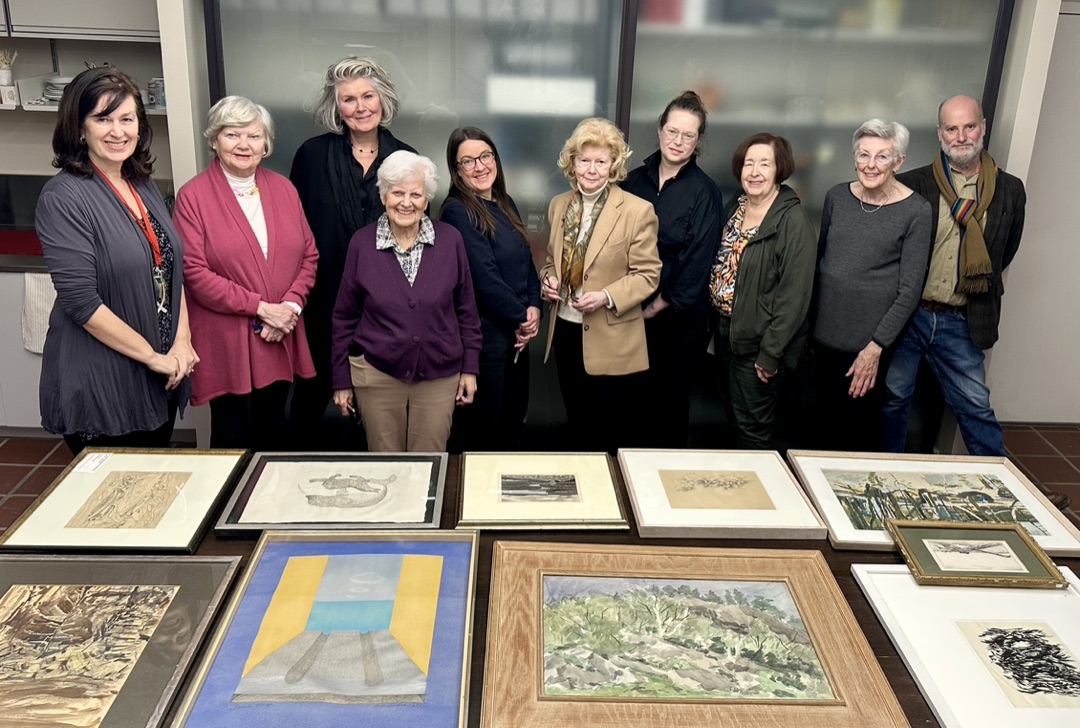
Jan Seger-Lambert; Sandy Brown; Lindsay Grant, Rolph-Bell Archivist; Nancy Forsyth; Jane Hutchison;
Maureen Simpson; Anne Greaves; Gregory Humeniuk
After their quarterly meeting wraps, the members of Trinity’s Art Committee don’t leave. Instead, they gather around a long table in the Trinity Archives, where a selection of recent donations — works being considered for the College’s new Lawson Centre for Sustainability — has been laid out. Before any piece can be hung in the College, it needs to be assessed for condition, context, and fit. The committee’s job is to look carefully and determine next steps.
Pencils in hand, ballots on the table, they move from work to work, making their own assessments. Each person brings a different eye: an art historian’s trained gaze, a curator’s instinct, a longtime collector’s feel for what can wait and what cannot. When the ballots are tallied, three works will move forward for restoration. The rest will wait.
It is a small, careful act of stewardship — one that happens several times a year, largely out of sight — that most Trinity alumni would never think to wonder about.
Behind the collection
Trinity’s Art Committee has been working in the background for decades, meeting three to four times a year under the leadership of its chair, with support from the Rolph-Bell Archivist. Its scope is broad: paintings, silver, antique furniture, tapestries, stained glass, and other works of value woven into the physical fabric of the College. The committee guides acquisitions and de-accessions, sets restoration priorities, administers loans from the collection, and commissions official portraits of provosts and chancellors. The collection itself has been built primarily through donations, with select works commissioned over the years.
“The College’s art collection is an important part of how our history is seen and understood. The committee also recognizes it as a living collection, and their volunteer work helps ensure it remains well cared for, accessible, and meaningful,” says Lindsay Grant, Rolph-Bell Archivist.
That commitment also extends to how the collection grows. Since 2022, reflecting the diversity of the Trinity community has been a formal criterion in acquisition decisions.
Who they are
The current committee brings together Ana White, Trinity’s Executive Director of Development & Alumni Affairs; Jane McMyn ’59; Jan Seger-Lambert ’74; Sandy Brown ’60; Nancy Forsyth ’70; Jane Hutchison ’05; Maureen Simpson ’74; Anne Greaves ’60; and Gregory Humeniuk ’93, who serves as chair. Together they represent a range of backgrounds — some with formal art training or professional experience in the field, others with a deep personal appreciation for art. As one member noted at this quarter’s meeting, there has never been a working artist on the committee. This is curatorial and institutional work: the kind that attracts people who find meaning in care and continuity.
For Brown, who came to the committee after a career as Executive Director of Alumni Affairs at Trinity, the role offers something unexpected. “It gives me a kind of connectivity with the College that nothing else does. When I tell people I’m going to an art committee meeting, nobody knows what that means. But that’s part of what makes it special — it’s a window into the College that very few people get to see,” Brown says.
McMyn has been a member since 1986, when Provost Kenneth Hare retired and Robert Painter became Trinity Provost — nearly four decades of service to a committee that has been quietly at work since the early 1970s. In that time, she has watched the committee evolve and the collection grow. Her recollections capture something of what that continuity means: “When Sylvia Lassam became archivist, she took a great interest in Trinity’s Art Committee and was very dedicated to the maintenance of the collection,” McMyn recalls. That dedication helped shape what the committee is today.
“What brings people here is a genuine love of the collection and of Trinity. The work asks you to think carefully about what a community holds in trust — and that’s not something everyone is drawn to, but for the people on this committee, it’s why we keep coming back,” Humeniuk adds.
A collection with real stakes
The works the committee tends are not decorative background. They include historically significant pieces — among them a remarkable collection of works by the Group of Seven — that have shaped the College’s visual identity across generations.
Maintaining a collection of this depth is active, ongoing work, and conservation is expensive. The committee’s annual restoration budget is modest. The ballot conducted at this quarter’s meeting is a reminder of that reality — not everything that needs attention can receive it at once. Choices have to be made, carefully and collectively.
Art and the people who live with it
Students have always been part of the picture. Over the years the committee has welcomed student involvement and supported student art shows — offering guidance on how to mount them and encouraging the kind of creative life that extends beyond the curriculum. But perhaps the committee’s most enduring contribution to student life is simply the collection itself.
“Students walk past these works every single day. They may not stop to think about them — but they see them. That quietly shapes how you see the world, even when you’re not paying attention to it. That’s part of what we’re protecting,” Humeniuk explains.
A bridge between old and new
Among the committee’s current projects is the selection of works for Trinity’s new Lawson Centre for Sustainability. Choosing what enters that space is, in its way, an act of translation — bringing pieces from a collection built over more than a century into a building designed for the next generation of students and the challenges they’ll inherit. The committee is thinking carefully about how Trinity’s history and visual identity can carry forward into a new kind of space, and what it means for the College’s past and future to share a wall.
Carrying it forward
Trinity’s Art Committee is at a natural moment of reflection. Long-serving members have given decades of careful attention to a collection most alumni never think about. The question of who comes next — and what they’ll bring — is one the group takes seriously. What draws someone to this work is not easy to summarize: part institutional loyalty, part love of art, part willingness to engage with questions that don’t always have obvious answers.
If that sounds like you, Trinity’s volunteer community is always looking for people who show up, stay, and care. And if you’d like to help ensure these works are preserved for future generations of students and alumni, the committee’s conservation work depends on the generosity of the broader Trinity community — please consider a directed gift to the Art Committee. To get involved or to give, please contact Lindsay Grant, Rolph-Bell Archivist, at trinity.archives@utoronto.ca.
Favourite works from the collection
Ask any member of Trinity’s Art Committee about their favourite piece, and you’ll get a different answer. We asked them to share — here’s what they said.

“It’s hard to name a favourite piece in the College’s collection, but I think the silver epergne is not only beautiful but also very important to the College’s history.” –Jane McMyn

“I find it difficult to vote on a favourite. And I’m not sure it’s in the job description of an Art Committee member to have favourites! But if pressed, I’d say AY Jackson’s Alberta Rhythm … And there is a lovely painting of ducks that used to be in the Private Dining Room, and other pictures that come as nice surprises in unlikely places — such as the austere Accounting office! My favourite thing about the collection is actually that it is everything (major and minor), and that it is everywhere throughout the College.” –Anne Greaves


“The [Franklin H.] Carmichael [October Haze] for the size, the colours, and the memories it still provokes of St. Hilda’s — sherry before Sunday lunch in the Rigby Room with The Group of Seven so close to us. It was like a beautiful painting in someone’s home, but it was our home. Also, the David Milne [Interior of the Painting House; Cabin Interior, Temagami] in the amazing library, where we all studied sometimes till 1 a.m. for exams in dressing gowns and slippers. The paintings enriched our living spaces.” –Jan Seger Lambert

“I was smitten by Sir Edmund Wyly Grier’s, Hon. G. W. Allan, Chancellor of Trinity University prior to my enrollment when it categorically embodied, ‘old formal portrait’ in an ‘old formal building.’ The art and accomplishment of the portrait kept it on my mind as I revisited it through my student years and after graduation. As I learned more about the artist, the sitter, the College, and the history of the city in subsequent decades, their exponential intersections deepened my appreciation and enjoyment of the portrait and the College.” –Gregory Humeniuk