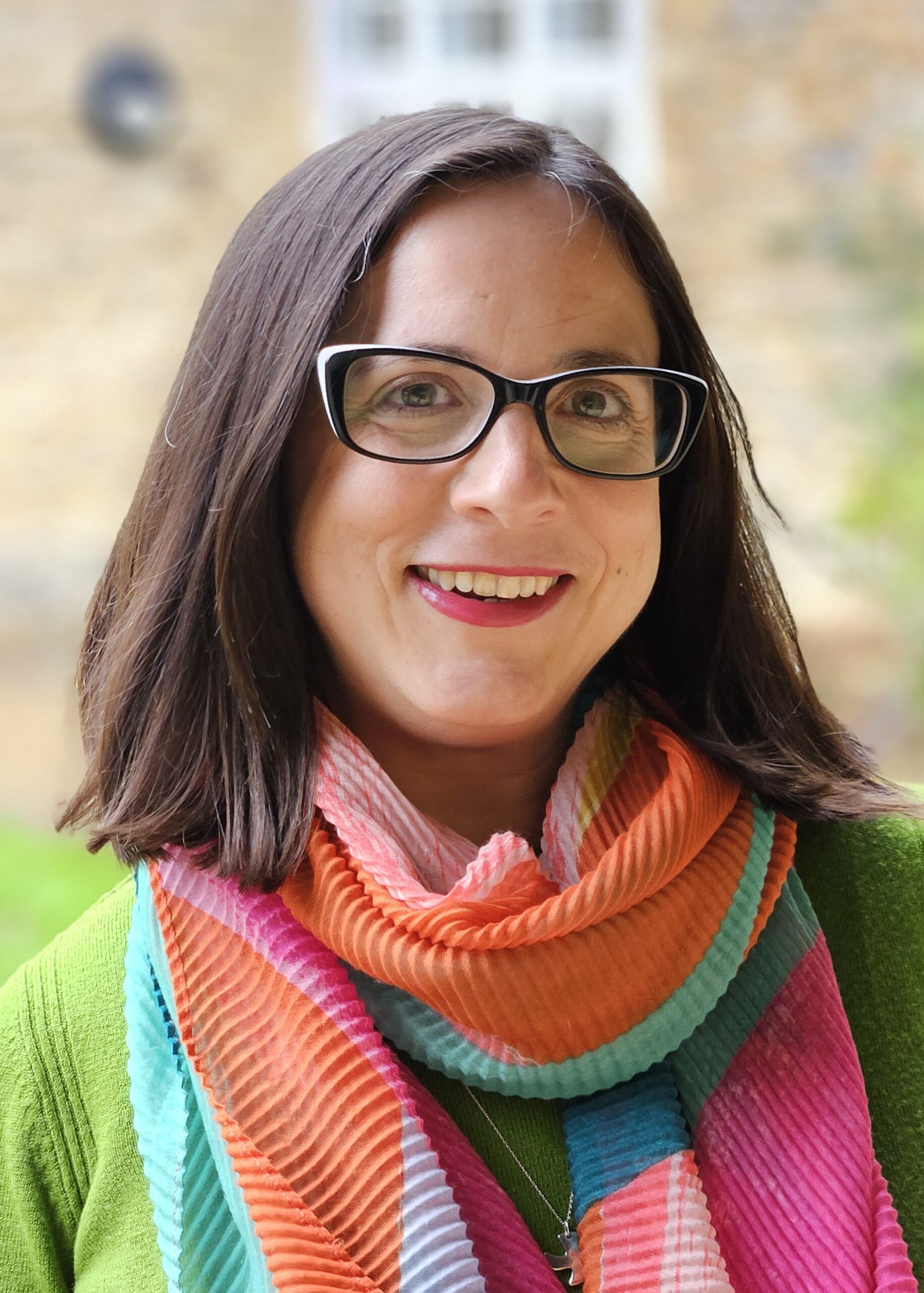

Natasha Klukach is a graduate of Trinity Arts (9T8) and Trinity Divinity (ThM ’15). She has a MTS from Queen’s University (2003) and although she began her doctoral studies at Trinity, she ultimately completed her PhD at King’s College London (England) in 2020 with a dissertation entitled Imago Dei From the Margins: A Gravitational Shift for the Ecumenical Movement.
Natasha is a lay theologian in the field of ecumenical relations. She served as Ecumenical Officer for the Anglican Church of Canada 2009-2010 and then as Programme Executive for Church and Ecumenical Relations for the World Council of Churches in Geneva 2011-2017. She was a tutor in theology at St Augustine’s College based in West Malling, Kent, where she still lives with her two dachshunds on the grounds of St Mary’s Abbey. From 2022-2025 she worked as the Ecumenical Theologian for World Vision International. She is presently the Director of Research and Operations for the Global Christian Forum.
1. Please describe what your present job is like.
The Global Christian Forum serves as a convening space for all Christian traditions, including those who may not formally associate with the ecumenical movement. I work closely with the World Council of Churches, the World Evangelical Alliance, the Pentecostal World Fellowship, and the Roman Catholic Church. Building relationships between individuals and churches requires trust; the charism of the Global Christian Forum is the sharing of faith stories as a foundation for that trust. I create opportunities to bring Christians together for dialogue, I research and write on ecumenical theology and global Christianity, I speak at conferences, and I attend significant events for the church around the world. I often describe the core of my work as though I’m responsible for preparing a dinner party. I try to create the conditions that will allow the conversation between those gathered to flourish and lead in directions none of us could have predicted, kind of a collaboration with the Holy Spirit!
2. What gave you your passion for ecumenical work?
At first, my interest was personal and experiential. I’m of mixed European heritage and while I was raised as an Anglican, I was fascinated as a young child with experiences of Ukrainian Orthodox liturgy and spirituality from my paternal family. When I was in my early 20s I was a volunteer at the Taizé Community in France for a summer. I built friendships with other young people from around the world representing different Christian traditions and it was life changing. I understood far more how theology, tradition, and culture intersect in different ways and began to situate myself within that tapestry.
Speeches that I heard at the 2006 World Council of Churches Assembly in Brazil by Archbishop Desmond Tutu and Archbishop Rowan Williams respectively articulated why the gift and calling of Christian unity was inextricably part of the nature and mission of the church and what that looked like from an Anglican perspective. That was the point at which ecumenism expanded from the relational to the theological for me and a scholarly passion was born.
3. How did your experience at Trinity prepare you for your ministry?
Trinity prepared me for my calling in two significant ways. Studying in the context of the Toronto School of Theology was formative. I had a ‘home’ at Trinity, reflective of my own Anglican identity, but my classes took place at varied colleges with ecumenical perspectives always present through professors and fellow students. I consider the theological education available at Trinity and TST to be exceptional and it gave me the skills and experience I needed to succeed in high-level ecumenical dialogues and develop as a researcher and writer.
Perhaps even more significant for building my professional life was mentorship by alumni. Trinity is impressive for the ecumenists it produces! Archbishop Michael Peers helped me find my way in international Anglican-Orthodox relations. Canon Dr Alyson Barnett-Cowan facilitated some of my early appointments to national and international ecumenical bilateral and multilateral dialogues. Canon Dr John Gibaut was a colleague at the World Council of Churches from whom I learned much about theological writing. My vocational development was also shaped by the ecumenical leadership of the Rev. Dr Eugene Fairweather, Bishop David Hamid, and Bishop Victoria Matthews among others. Ecumenical theology and church relations seem to be part of Trinity’s DNA.
4. You have experienced the Christian Church in a vast array of its expressions, in virtually all parts of the world. What have been the most compelling examples of Christian life and witness that you have seen?
It is very hard to choose just a few examples! I could talk about churches addressing environmental crises in the Pacific, witnessing to faith under severe persecution in parts of the Middle East, historic and current advocacy and action against racism in North America, monastic life in Eastern Europe, efforts in interreligious dialogue and peacebuilding in parts of Africa and Asia, faith-based humanitarian and development work in Latin America, the ecumenical significance of agreed texts such as the Joint Declaration on the Doctrine of Justification, and the list goes on and on. All have moved me and deepened my own faith in ways I simply can’t articulate.
Ultimately, though, I find everyday discipleship wherever in the world it is being lived profoundly most compelling. Every Christian bears witness in different ways and the greatest privilege of the work I have been doing has been glimpsing so many of these individual faith stories and seeing how God is at work in the lives of people who are very different from one another.
5. With the rise of militarism, racism and oppression around the world, what do you hope that faith communities can do?
Most days, it is only my faith that gives me hope in the midst of such turbulence.
Clearly, the witness of Christians to the gospel of peace, human dignity, justice, and love is an essential response and that takes many forms – protest, caring for the most vulnerable in our societies, and speaking truth to power are all examples of what people of faith can do.
But perhaps as Christians the effectiveness of what we do depends on being clear about who and what we are called to be. Intentional discipleship and a deep spiritual and sacramental life can’t help but lead to ways of rejecting hate and embracing all that leads to fullness of life. That may sound simplistic and often inadequate, but it is by seeking to emulate Christ that what we need to do in any situation becomes clear.
And a bonus question, just for fun: why dachshunds?
Dachshunds are the salt of the earth.

Published March 2026