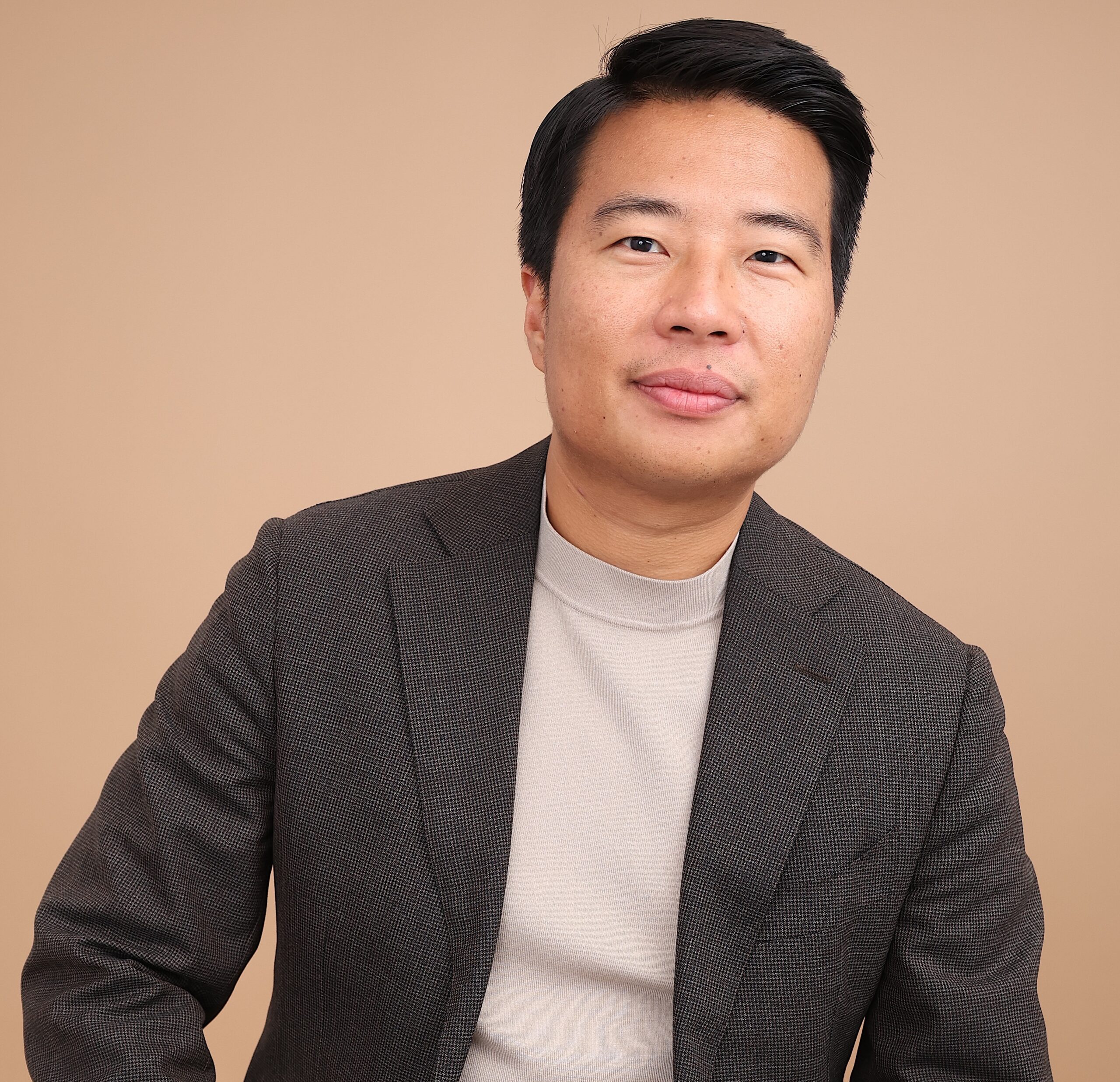

Steven Wang ’11 is CEO of Venture for Canada, a national charity that equips young Canadians with entrepreneurial skills, mindset and opportunities — and increasingly, the ability to navigate a 21st-century economy shaped by artificial intelligence (AI). A lecturer who teaches global affairs and AI governance, including at Harvard, Wang returns to Trinity as instructor in the 2025–26 academic year. The new course he is co-teaching (with fellow alum Christie Bates ’11), AI, Governance and Democracy: Legal, Ethical and Policy Frontiers, brings current, real-world questions about law, policy, and emerging technology straight into the classroom. Last November, he also helped launch Trinity’s new lecture series, Trinity Minds on Hot Topics, serving as moderator for the inaugural discussion, Using AI Responsibly. It was a conversation that emphasized a clear theme: AI is most valuable when it organizes complexity for human experts, rather than replacing human judgment.
TRINITY: When people hear “AI,” they often swing between hype and fear. In plain language, what does “responsible AI” actually mean — and what are two or three things every Trinity student/alumnus should understand right now to think clearly about it?
STEVEN: One way to understand “responsible AI” is something quite practical: using powerful tools in ways that enhance human judgment, rather than replace it, and doing so with a clear understanding of who benefits, who bears risk, and who remains accountable. First, AI systems are not neutral. They reflect the incentives, data, and assumptions of the institutions that build and deploy them. That means questions of power, bias, and governance don’t disappear just because something is automated. Second, AI is a general-purpose organizing technology and its real value often lies in helping experts see patterns, manage complexity, and make better decisions, not in fully automating decisions that carry moral or social weight. And third, responsibility is not just a technical problem; it’s a civic one. Laws, norms, professional ethics, and public trust matter just as much as code. Thinking clearly about AI requires crossing disciplines, something Trinity has always encouraged its students to do.
TRINITY: For readers who don’t know Venture for Canada: It’s a national charity focused on helping young Canadians build entrepreneurial skills and access startup/small business opportunities. As CEO, how do you see that mission evolving in an AI-shaped economy — and what mindsets or skills do you hope places like Trinity help graduates build over the next five years?
STEVEN: At Venture for Canada, we work closely with early-career Canadians and with small and medium-sized businesses across the country. What we see on the ground is not fear of AI, but uncertainty, especially about how to use new tools responsibly and productively in real work environments.
Our mission is increasingly about bridging potential and proof. That means giving young Canadians real responsibility early, helping them develop judgment, adaptability, and confidence, not just technical skills. AI will change how work gets done, but those human capabilities matter more than ever. For places like Trinity, I hope graduates leave with a comfort with uncertainty, a sense of moral responsibility for the systems they work within, and the habit of lifelong learning. AI literacy matters, but character, curiosity, and judgment matter just as much or even more.
TRINITY: You moderated Trinity’s inaugural Trinity Minds on Hot Topics discussion, Using AI Responsibly, in November 2025. What role can the Trinity community play right now – not in building AI, but in shaping how society uses it?
STEVEN: Not everyone needs to build AI systems. But many Trinity students and alumni will shape how AI is used in classrooms, boardrooms, courtrooms, hospitals, newsrooms, and public institutions. Trinity’s real strength has always been its culture of thoughtful engagement. The community can help push conversations beyond hype and fear, insist on ethical reflection alongside innovation, and model what it looks like to approach powerful technologies with humility rather than certainty. Alumni in particular have influence where norms are still being formed. Sometimes that means asking better questions, slowing things down, or reminding colleagues that efficiency isn’t the same as wisdom.
TRINITY: You’re teaching AI, Governance and Democracy at Trinity. The term has just begun, but what are students most curious about? What do you notice about the Trinity students in your course, and what’s distinctive about how they approach these questions compared with other classrooms you’ve taught in?
STEVEN: Students are deeply curious about questions of power and legitimacy: who gets to decide how AI is deployed, whether democratic institutions can keep up, and what accountability should look like when systems become more complex and opaque. What stands out to me about Trinity students is their comfort with nuance. They’re not looking for easy answers. Many bring historical, philosophical, or ethical perspectives into conversations that are often treated as purely technical elsewhere. There’s a genuine willingness to ask, “What kind of society do we want to build, and what trade-offs are we willing to make?” That makes for a very special classroom.
TRINITY: Looking ahead, what makes you hopeful about AI in Canada or for Canadians? What is a risk or a danger that keeps you up at night that you think Canadians should pay attention to as AI becomes more embedded in daily life?
STEVEN: I’m hopeful because Canada has strong research institutions, a tradition of public-interest governance, and a growing recognition that AI policy is not just about innovation, but about trust. There is real potential for Canada to model on the global stage a more balanced approach — one that values economic dynamism alongside social responsibility. What worries me is complacency in the world. If AI systems quietly reshape labour markets, public services, or information ecosystems without public understanding or oversight, we risk hollowing out democratic accountability. The danger isn’t dramatic malfunction; it’s gradual normalization without consent or scrutiny.
BONUS QUESTIONS
TRINITY: What’s a Trinity experience (a course, a conversation, a community) that still shapes how you think about big public questions?
STEVEN: While I learned a lot from my Trinity One and my upper-year seminars, what stays with me most is the culture of conversation around the College — late-night debates in the Quad, interdisciplinary chats over lunch in Strachan Hall, and just the sense that ideas mattered beyond exams. Trinity taught me that public questions deserve seriousness and care, and that intellectual rigor and civic responsibility belong together.
TRINITY: What do you make time for that keeps you grounded — even when things are busy?
STEVEN: Last year I started doing cold plunges! While painful, they provide me with a sense of clarity. I also try to make time for reading, exercise, and long, unstructured conversations with friends. Teaching keeps me grounded too; standing in front of students forces clarity and humility. And staying close to family and old friends from Trinity, which helps keep me grounded with all the changes in the world.