From sacred architecture to urgent conversations, the Trinity Chapel remains the spiritual and communal heart of the College — open to all.

Entering the Trinity Chapel for the first time is an unforgettable experience. Sunlight streams through the soaring stained-glass windows, illuminating limestone pillars and oak pews worn smooth by generations of students, faculty, alumni, and friends. Silence here feels golden, eclipsed only by the thrill of hearing the pipe organ, its resonant sound swelling beneath the choir’s harmonies.
If Trinity College is an architectural gem, the Chapel is the jewel in its crown. For 70 years, this sacred space has offered beauty, a sense of awe, and a feeling of belonging. Rooted in Anglican tradition yet open to all, it continues to be a place where the entire community can gather for reflection, music, and meaning.
A shining example of architecture and generosity
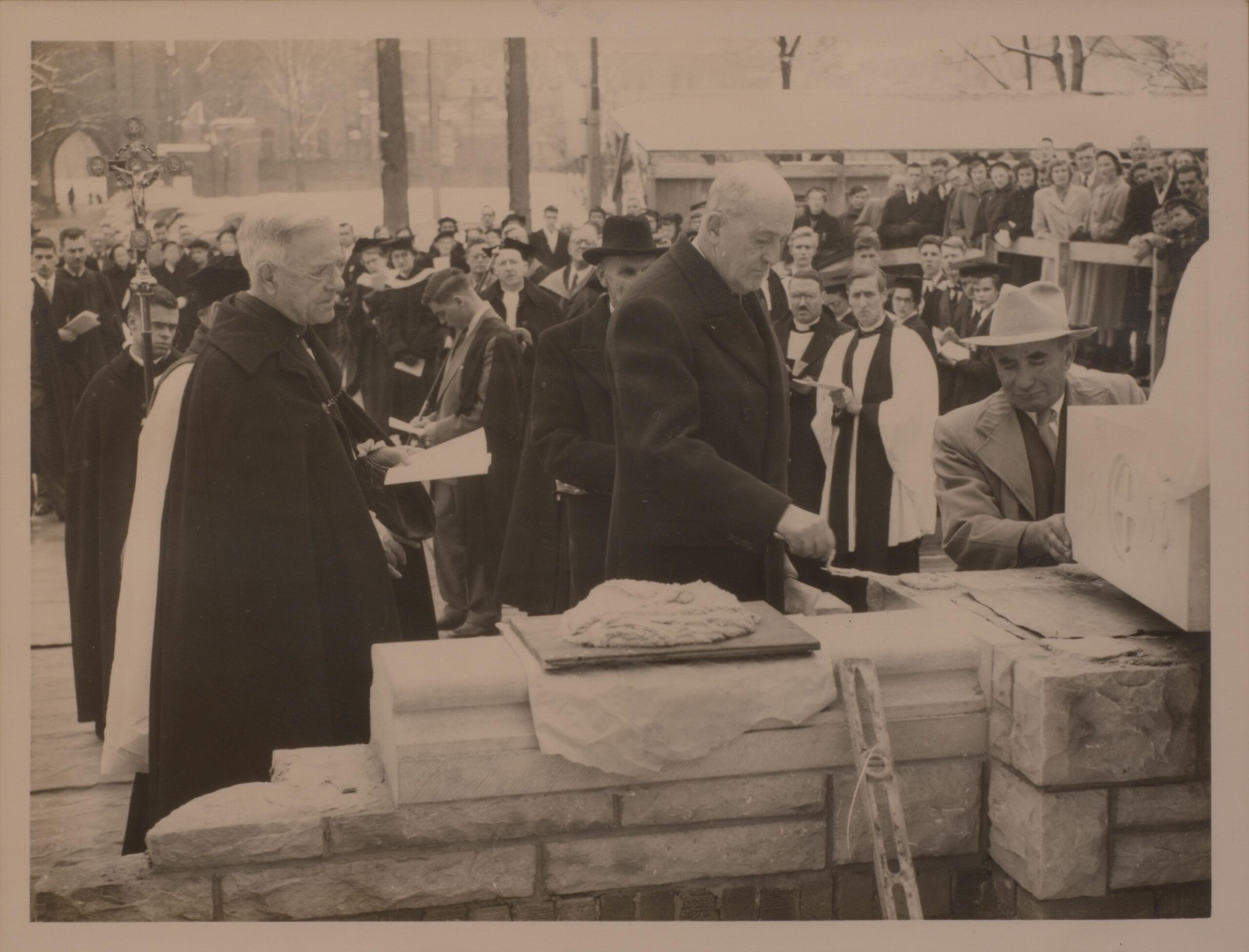
Consecrated on November 20, 1955, the Trinity Chapel was designed by Sir Giles Gilbert Scott, the renowned architect of Liverpool Cathedral and British red telephone boxes. With its Gothic arches, Indiana limestone supports and stuccowork interior, sandstone exterior, and Roman travertine floor, the Chapel embodies the College’s vision of a space that uplifts both spirit and intellect.
Its creation was made possible by the extraordinary generosity of Gerald Larkin, president of the Salada Tea Company, enabling the College to fulfill its long-held dream of building a permanent place of worship on the Hoskin Avenue campus. Prior to the Chapel’s construction, Seeley Hall served as the College’s main worship space.
From its earliest days, the Chapel has linked past and present. In the small porch off the Chapel’s east-side exit, a set of stained-glass windows crafted in 1887 by Toronto’s Joseph McCausland & Co. were brought from Trinity’s former Queen Street chapel. The windows within the main worship space, however, were designed by E. Liddall Armitage of Whitefriars Studio, a frequent collaborator of Sir Giles Scott. Their plain glazing, accented by occasional touches of colour, allows natural light to pour into the nave — an intentional expression of simplicity and calm.
A gathering place for every season
It is often reported that the first service held in the Trinity Chapel was a wedding in September 1955, two months before the building’s formal consecration. Since then, countless ceremonies — weddings, baptisms, memorials, and convocations — have been celebrated within its stone walls.
The Chapel also houses several memorials honouring members of the Trinity community who gave their lives in war. A limestone tablet designed by Allan George, with lettering and medallions by A. Scott Carter, commemorates those who died in the First and Second World Wars. Bronze plaques honour other fallen alumni, while just outside the entrance, a three-panel illuminated Honour Roll, completed by Canadian artist Jack McNie in 1942, bears the names of approximately 1,000 men and women of Trinity College who served their country.
Over the decades, the Chapel has hosted moments that reflect both reverence and relevance. Archbishop Desmond Tutu preached here in 2000, calling on the College to be a voice for justice. The author Robertson Davies was remembered here in 1995. More recently, the Chapel has provided the setting for interfaith gatherings, student vigils, and conversations that bring faith and scholarship together.
It also serves as a living classroom for Divinity students, including those in the Master of Divinity program, who learn and practise their future vocation within its walls. Community services such as weekly Choral Evensong bring together Divinity students, the Chapel Choir, and the wider College community in shared worship and reflection.
The upcoming 70th-anniversary symposium, Sustaining Hope and Seeking Justice in Challenging Times, continues this tradition of dialogue. Taking place November 18–20, it will welcome faith leaders from Anglican, Jewish, Buddhist, and other traditions, including keynote addresses by Bishop Michael Curry and Archbishop Linda Nicholls. In addition, a conference, Sacred Space: Conflict and Convergences will explore how sacred spaces can be grounds for conversation, healing, and action — a fitting theme for the Chapel’s milestone year. Find out about Chapel Celebrations
In these ways, the Trinity Chapel remains a living heart of the College. Students still slip into its pews before exams; alumni return to mark life’s milestones; visitors pause at midday to reflect in the light-filled space. For generations, its open doors have welcomed moments of study, worship, music, and remembrance — all expressions of a community united by reflection, learning, and care.
Music that lifts the soul
Music has always been central to the Chapel’s identity. Built in 1954 by Casavant Frères of Saint-Hyacinthe, Quebec — and restored by the same firm 70 years later — the organ was voiced under the guidance of Dr. Healey Willan and Sir Ernest MacMillan, two of Canada’s foremost 20th-century musicians. From the first notes sounded at the consecration to today’s services, its rich tones have filled the Chapel with both reverence and joy.
The Chapel Choir continues to anchor this musical life, joined by generations of Bevan Organ Scholars who have honed their craft at the console. Under the leadership of dedicated directors of music — from Dr. Willis Noble to the long-serving Dr. John Tuttle and now Thomas Bell — the Chapel’s musical tradition has thrived. A special concert by the Chapel Choir will take place on November 19, 2025 at 5:00pm as part of the anniversary celebrations.

In recent years, restoration work by Casavant has renewed the organ’s voice. Once-silent trumpet pipes now blaze again, and a newly restored 32-foot bass stop deepens the sound that rolls through the nave. These efforts, made possible by generous donors, ensure that the Chapel’s music will continue to inspire future generations.
Beyond stone and sound
For all its grandeur, the Trinity Chapel’s lasting power lies not in its architecture or acoustics but in its welcome. Each week, services and concerts draw people from across campus and beyond — students of every background, faculty, alumni, and neighbours. It is a place of Anglican worship and community life, but also a home for those of other faiths, and of none, who come seeking quiet or connection. As the Rev. Paige Souter, Humphrys Chaplain, reflects: [“The Chapel reminds us that beauty and belonging are not luxuries, but essentials. Whether you come for prayer, for music, or simply for a moment of stillness, you are welcome.” — placeholder quote to be confirmed]
That sense of belonging — grounded in ritual yet open to change — is what has sustained the Chapel for 70 years.
Looking ahead
As the College celebrates this milestone, the Trinity Chapel continues to be both a sanctuary and a space of engagement. From morning prayers to midnight reflection, from sacred music to social justice forums, it holds the harmonies and contradictions of community life.
Its stone walls may be unchanging, but within them the conversations evolve — about faith and doubt, identity and purpose, justice and hope. That continuity amid change is what makes the Trinity Chapel a living symbol of the College itself.
by Jennifer Matthews
As we mark 70 years of the Trinity Chapel, we invite you to help preserve the beauty, music, and welcome that define it. A gift to the Trinity Fund supports the Chapel and the College’s historic buildings, ensuring these spaces remain places of refuge, inspiration, and community for generations to come. Make a gift to the Trinity Fund