By Jennifer Matthews

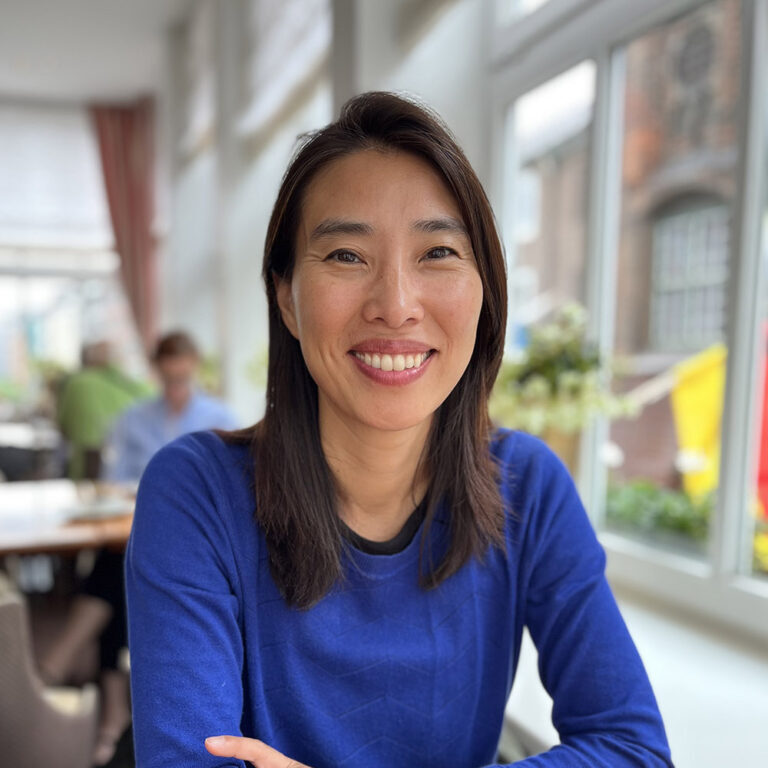
Professor Hang-Sun Kim became Trinity’s 14th Dean of Arts and Vice-Provost on July 1. She is the first woman to hold the role. An Associate Professor of German, teaching stream, and Associate Chair, Undergraduate in U of T’s Department of Germanic Languages and Literatures, Kim has spent much of her career focused on undergraduate teaching and curriculum design. In 2022 she received a Faculty of Arts & Science Outstanding Teaching Award. A few months into her new role, we caught up with her to talk about first impressions, the undergraduate journey, growing up between languages and cultures, and why learning should stay effortful in the age of AI.
Welcome to Trinity! You first came to U of T as an undergraduate, completed your master’s degree here, and, after earning your PhD at Harvard, joined U of T’s German Department as a faculty member in 2014. After all that time at the university, what drew you to Trinity?
Hang-Sun Kim: The reputation of Trinity students precedes them. They were my peers when I was an undergraduate, and I’ve often had Trinity students in my classes as an instructor. I was always incredibly impressed: They seemed so together and engaged, and they knew how to navigate the university. It made me curious about the secret — the magic — behind the college that attracts and produces such amazing students.
When I learned about this role, I was drawn to Trinity’s scale and to the small, seminar-based learning that its academic programs are built on. I come from a background where that’s a priority, and I’m very committed to education on a human scale. U of T is a very big university, and to me, it’s important that students don’t feel anonymous in the classroom. That’s best addressed in small classes, where students get to know their instructors and their peers, and form relationships that can lead to lasting friendships well beyond their time at the university.
You joined Trinity in July, just ahead of the new academic year. As someone who has spent years thinking about how students develop over the four years or more it takes to complete an entire degree, what stood out as the year got underway?
HSK: The tremendous energy at the start of the term was incredible. I was lucky to arrive in time to see the opening of the academic year, and to witness some of the rituals that mark important milestones in a student’s life. Trinity does such a great job of creating those moments so students see not only their own progress, but also their connection to the broader Trinity community.
Matriculation was wonderful. Students make a pledge, so they immediately become part of this community, making a commitment both intellectually and socially. The speeches are still delivered in Latin, but they’re translated, so you keep the ritual while modernizing it to be inclusive. And there was a whole group of Dons and senior students near the front of the stage cheering on every single student who came up to sign the book. They must have been hoarse by the end!
I’ve spent many years thinking not just about individual classes, but about the whole undergraduate journey, from first to fourth year. In the German Studies department, I helped design pathways that map how learning progresses across a whole degree. That taught me that education isn’t only about accumulating knowledge and developing skills, but also about forming habits of mind and growing as a person. As Dean of Arts, I’m excited about the opportunity to think about this even more broadly.
You were born in South Korea, moved to Germany when you were five, and later came to Canada. How has growing up between languages and cultures shaped the way you teach and lead?
HSK: German didn’t start out as an academic interest for me. It’s the language in which I formed my early friendships and learned many songs and poems — poems I had to memorize for school. Over the years, that married very well with my interest in literature, which opens worlds, allowing us to peek into people’s experiences, imagination, and desires. My doctoral dissertation focused on the Austrian writer Hugo von Hofmannsthal, who wrote with an awareness of being surrounded by many languages and cultures as the Habsburg Empire was coming apart. That resonated with me.
Korean was my first language, and I still speak it with my parents. I learned French after coming to Canada. When my family gets together, we fluidly mix Korean, German, and English — linguists call that translanguaging. I’ll even take a Korean word and put a German ending on it.
My son doesn’t speak German or Korean beyond a few essential words — “grandma,” “I love you,” and “milk” — but hearing them at home and around my parents has given him a heightened awareness that there isn’t always an equivalent for an English word in another language. Each language might open up a different way of seeing the world and being in it.
I see that in myself, too. Growing up between languages and cultures from an early age gave me that same awareness — that the things that may seem self-evident to you from one cultural lens will not be from another. I think that informs the way I am as a teacher, and hopefully also as a leader. To me, it means you don’t take things for granted, you have to listen carefully, and you approach different situations with openness and curiosity. There’s a lot of strength that comes from being able to engage with difference — and not just seek uniformity.
As a professor of language and literature, you’ve taken part in many discussions among educators about AI literacy. How do you see generative AI affecting learning?
HSK: I’m quite worried, actually, about what AI is going to do to learning. Reading and writing are very closely linked with our ability to think. There are certain perfunctory things you can do really well with AI, but I see a tendency for students to say, “I’m just going to use it for outlining, or for writing a proposal.” But it’s important to recognize that there’s thinking that happens even at that early stage.
Whether or not we embrace AI in the classroom, I think educators agree that it’s important to tell students that learning is effortful, and that there’s something very rewarding when you persevere. Writing isn’t easy; AI just makes it look easy. Many educators talk about keeping the human in the loop — you still need to exercise your judgment, make intelligent assessments of what you’re reading, and remain a critical thinker. Can that happen if you outsource the thinking altogether?
Trinity’s community reaches well beyond its current students — to faculty, staff, alumni, and the wider U of T community. Where do you see alumni fitting in?
HSK: That intergenerational aspect is something that intrigues me about Trinity. Learning isn’t just happening in the classroom. Students belong to a community, which means getting to know not just their professors, but the staff who make the whole place happen. Trinity has also positioned itself as a place for public debate, so there’s a connection between students, alumni, faculty, and staff, and a reaching out to the broader community.
I’m still struggling to wrap my mind around how our academic directors — and the alumni team — manage to mount so many different events. We have visiting scholars, and lectures from politicians, and former diplomats, or other experts, and academic dinners organized by our academic dons, where students sit alongside professors and accomplished alumni and learn from people in other disciplines.
I’ve also been talking with our academic directors about expanding community-engaged learning and internship opportunities for our undergraduates. This is where alumni can contribute so much. We’re already very aware that our alumni are eager to engage with our students, and that’s something I’d like to see us build on.
BONUS QUESTIONS…
What do you like to do outside of work?
HSK: I spent my childhood in Münster, which is the bicycle capital of Germany, so I developed a love for cycling at an early age, and I still love biking. I’m also a real city stroller. When I have time, I love walking in the city, discovering new corners, sitting in cafés, and getting into unexpected conversations with strangers. I have to credit my husband for that: He grew up in rural Ontario, and wherever we walk, he gets into the most interesting conversations. I’ve learned from him to remain open.
I’m also a film lover. As an undergrad, I lived across from the Cinematheque when it was at the Art Gallery of Ontario, and that’s how I developed my love for French and Italian New Wave cinema. I think it started because I was just being pretentious, but then I developed a real love for it. Federico Fellini, Agnès Jaoui, and Alice Rohrwacher are among my favourite filmmakers.
What have you been reading lately?
HSK: I recently read Greek Lessons by the Nobel Prize-winning Korean author Han Kang. It explores the limits of language and the fragility of human connection, which feels like a returning theme in my life. I read it in English, and it inspired a conversation with my father, who studied ancient Greek, about what it’s like to read the book in its original Korean — Greek characters even appear in the text every now and then. I’m also really enjoying Zadie Smith’s latest essay collection, Dead and Alive. She writes with so much wit about the human condition, and about big things that are happening now.


Left: Hang-Sun and her family bundled up for winter; Right: Hang-Sun and her husband in Lübeck, Germany