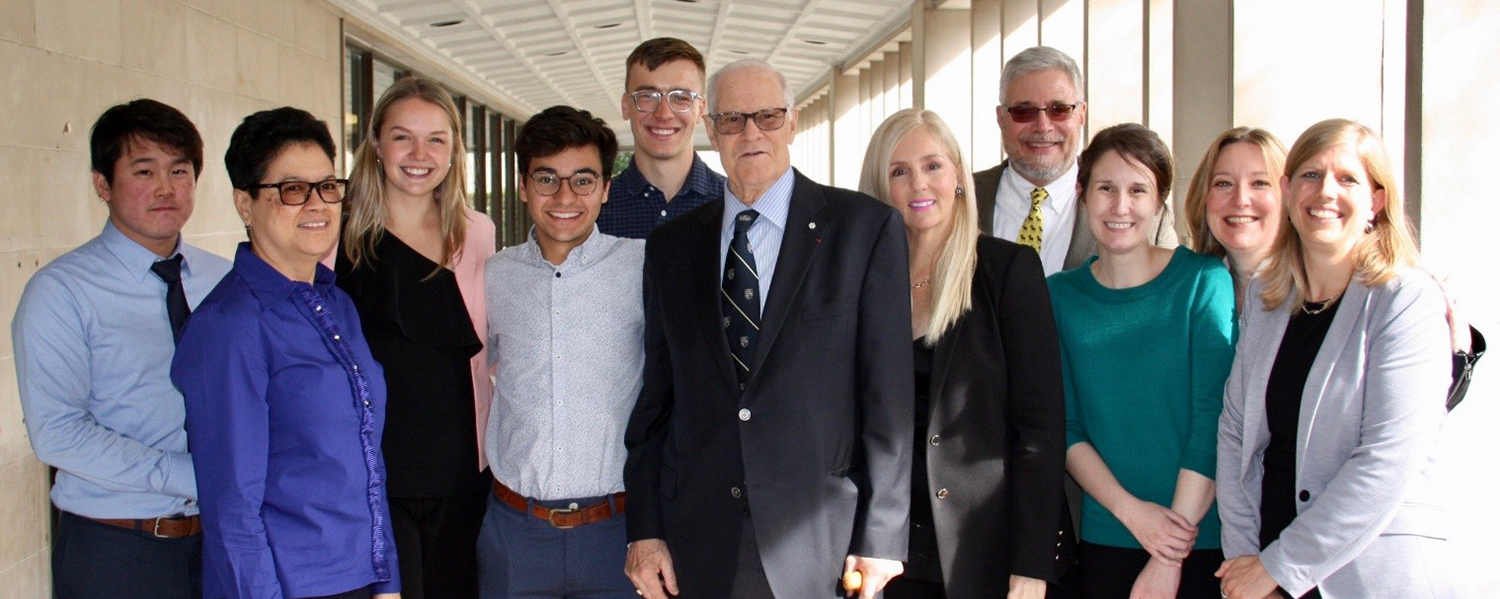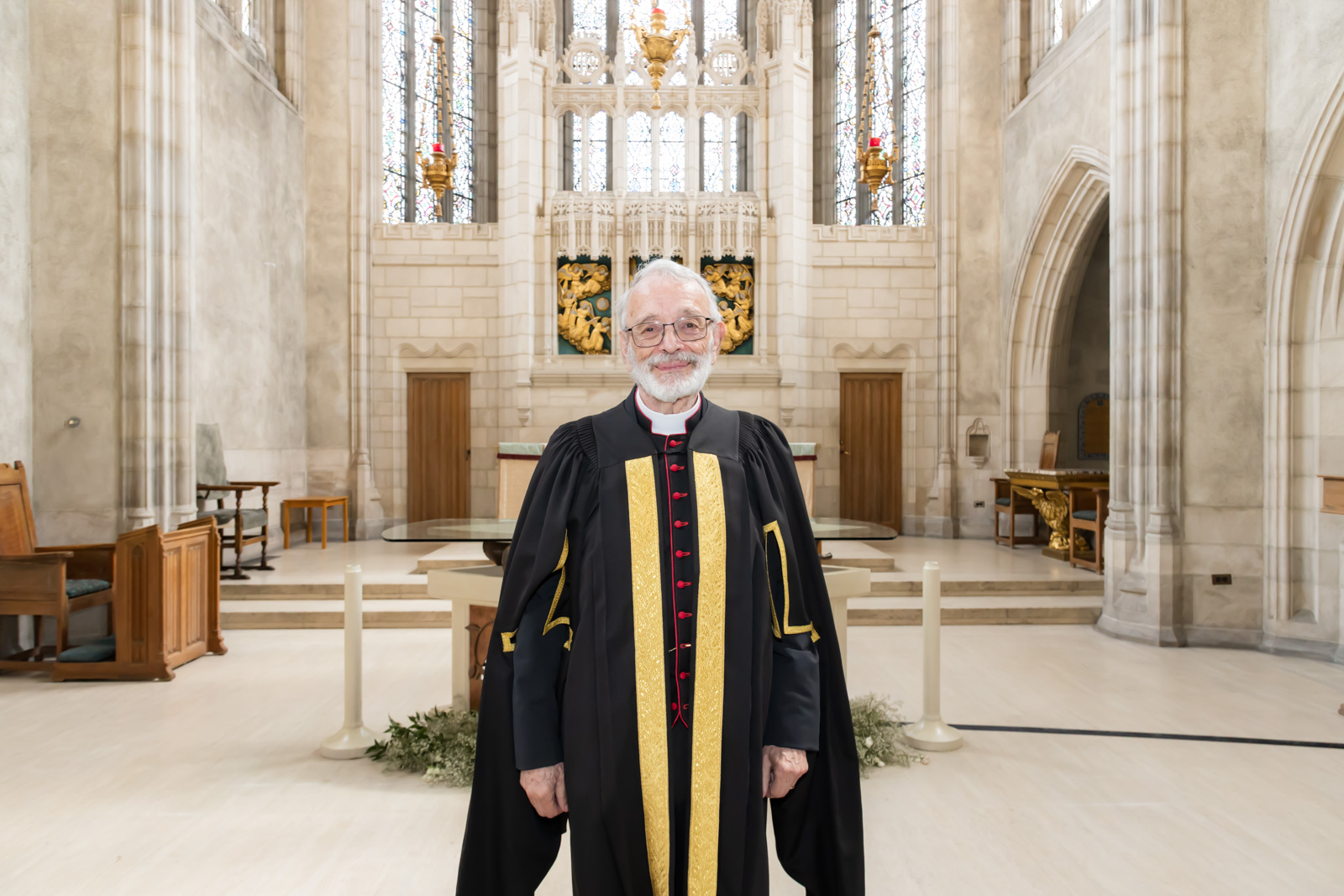

At Convocation on May 12, the Faculty of Divinity admitted the Rev. Canon Dr. W. David Neelands as an Honorary Fellow of Trinity College. The occasion honoured Neelands’ remarkable service to the College as student, lecturer, Registrar, Dean of Men, Dean of Divinity, and scholar over more than six decades. Dean of Divinity Christopher Brittain presented the honour.
In his remarks, Brittain set aside the shepherd metaphors of David’s biblical namesake to dwell on a different image: David as the pastor who patiently takes on the difficult cases. Over the years there were so many students for whom David’s support made all the difference, explained Brittain, including himself among them. How fitting, then, that the motto on David’s armorial bearings reads: “Not for oneself, but for the other.”
In his own address to Convocation, David offered a reflection on what 65 years at Trinity have taught him about community, learning, and the value of staying in the room with people who do not share your views. We are pleased to share an edited version of his remarks below. Readers who would like to learn more may read Trinity magazine’s 2017 profile of Neelands.
Address to Convocation
By the Rev. Canon Dr. W. David Neelands (Edited and condensed for length)
Sixty-five years ago, I entered Trinity College as the Peter Larkin Scholar. An active debate in my family suggested I should really be attending Victoria College, which my father’s family had helped to found generations earlier, and my grandmother arranged for leaders at Vic to try to convince me. We had lots of connections with Trinity, including a family member who was the first professor of Anatomy in the Trinity medical school, and some female doctors who graduated from Trinity. But I stood my ground and said I wanted Trinity.
I had supposed I would be entering the Math, Physics and Chemistry program here, but I had begun to reconsider that when I read the philosopher Bertrand Russell and pondered his various observations about mathematicians as never knowing what they were talking about or whether what they were saying was true. With the help of my French teacher at high school, I recognized that I would be happier studying philosophy than mathematics, and began to read philosophers in the school library. When I came to Trinity and was interviewed by Provost Owen, I had to confess that I admired René Descartes, who seemed to prove all knowledge deductively. Provost Owen winced and observed that I might change my mind on that. I did.
Philosophy at Trinity in 1961 was totally engaging, under the leadership of George Edison and Helen Hardy. We did read Locke, Berkeley and Hume, but it was the texts of Plato and Aristotle that arrested my interest — and the discovery of the free-ranging conversations with idle young people attributed to Socrates, and mirrored in our classes. It did not matter if you could prove your point; it mattered that you could announce it to others and hear the diverse opinions they had to offer.
Just like the diverse opinions of the classes of that Jewish Socrates Jesus of Nazareth, as I came to discover. Neither Jesus nor Socrates left any written texts, and both were executed for corrupting their followers. But their conversations became immortal. Both spoke to strangers and outcasts as their conversation partners, many with diverse opinions, and those conversations have survived. If we can stay in the room and keep inter-personal conversation alive, we may have some hope to make progress in a community.
And it was a community that I found at Trinity. John Henry Newman made a point when he opined that the essence of a university is the Common Room. We lived for the student life of this place: the Dramatic Societies, the debates of the Lit, the Chapel, the Athletic Societies, the “Conversats” (our dances that were called discussions!), the Senior Common Room, the demonstrations in front of the American consulate, when we got to stay laughing and chatting together all night under tarpaulins to keep off the rain.
Philosophy took another turn — except at St. Michael’s College, where scholasticism survived — abandoning the curriculum of classical texts in favour of so-called “linguistic analysis,” intriguing but shallow. I remember observing to one of my fellow graduate students that I wished we could return to debating about what made people happy, and being told I should move to the Anthropology department. So my curiosity turned to historical theology, where scholastic pluralism survived (a little), and I got an opportunity to study at Oxford.
I cannot say how much that interruption at Oxford meant to me. Once again, our tutorials allowed in-person discussion and the freedom to address the controversies we wanted to. The lectures on historical texts were breath-taking, at least for me. I discovered St. Augustine, who will always keep you guessing, and eventually his sixteenth-century replica, Richard Hooker, whom I had already encountered in English literature courses. At Oxford I also listened to Professor George Caird, whose classes on New Testament theology were structured as debates among the supposed New Testament authors. Professor Caird would introduce a topic, then ask one author to comment on it, then another to offer their opinion. In the end, the topic was thoroughly enriched by debate instead of systematic announcement.
When I returned to Trinity, I discovered that I would become College Registrar, and would remain so for 15 years, five of them as Dean of Men Students as well. This allowed me to relate to our students outside the classroom — perhaps the most important experience of my life, where interpersonal conversation was available daily. I was later invited to Simcoe Hall for 11 years to try to manage what were called “student affairs,” where my conversations tended to involve elected student representatives rather than the diverse rank and file I had known. Our leadership was wonderful, and I cannot say how much I valued the presidents and provosts I worked for there. But I knew my trajectory had to leave the wholesale in student life and try to regain the retail.
Eventually, I landed in the dean’s position in the Faculty of Divinity — a small faculty where we could know each other and discuss things freely. The faculty members were part of the conversations, and our amazing administrative staff could fill in any gaps during the day and on the weekends. And so, as I reflect after these sixty-five years, I savour the in-person life of Trinity, where we can still talk to each other, where diversity of opinion may actually lead to wisdom, where historical theology may survive with all of its scholastic pluralism, and not lodge in the echo chambers of so-called “schools” — personal conversation as in the cockpit of Artemis II.