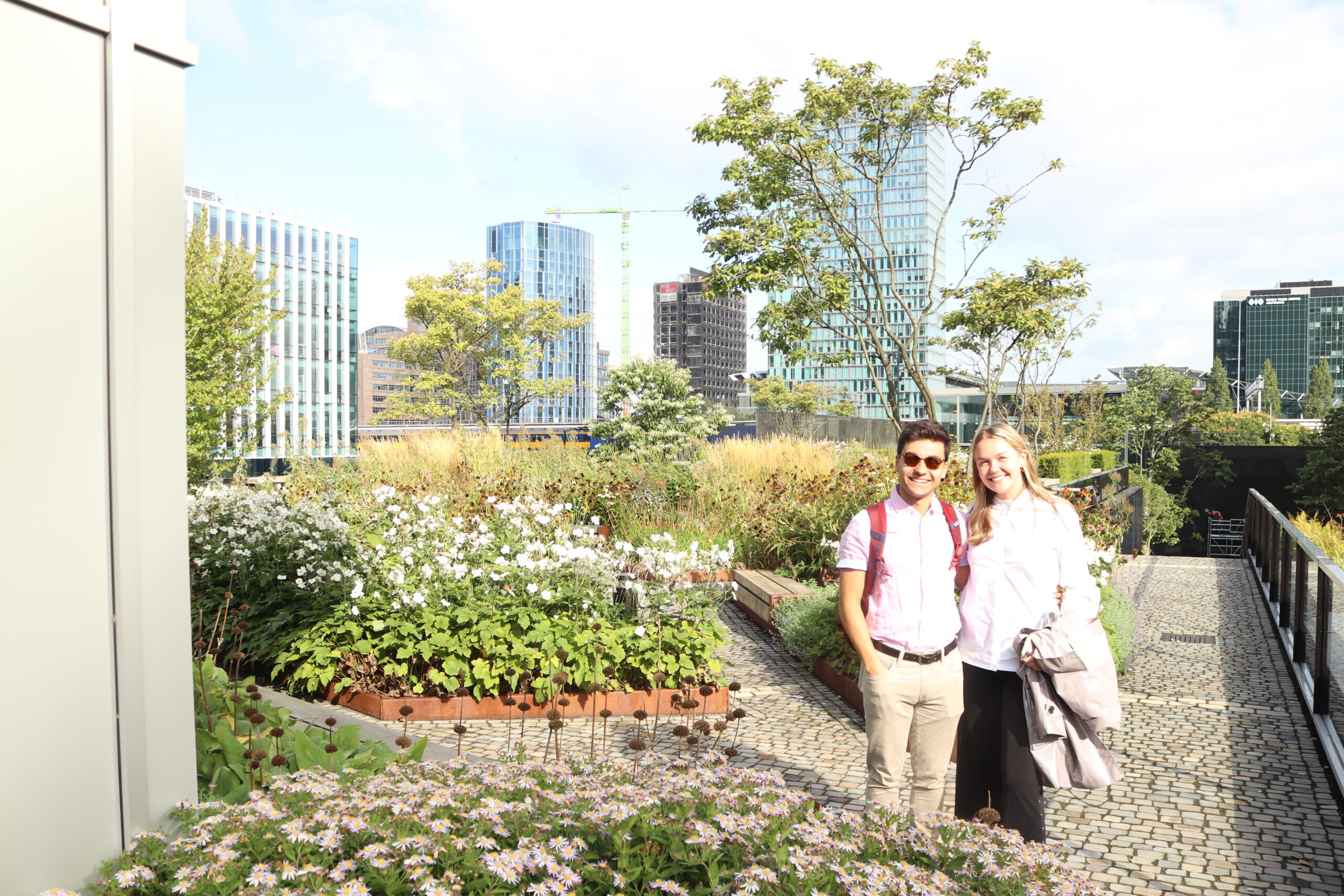

When the Lawson Centre for Sustainability opens in 2026, it will mark one of the most significant additions to Trinity’s campus in generations. Long before the construction fences went up, student voices helped inform early thinking about the project — including during a 2019 Trinity delegation to meet with Mecanoo, the building’s architects, in the Netherlands.
Two students, now alumni, who took part in those early discussions, Sebastian Warma and Christine Sutcliffe (both members of the class of 2021 and recipients of the 2019 Chancellor William C. Graham Award), reflect on what motivated them as students and what the Lawson Centre represents for the future of life at Trinity.
What motivated you to get involved in the planning for the Lawson Centre? What did sustainability mean to you as Trinity students?
SEBASTIAN:
“I was motivated by the historic opportunity itself. Knowing that the only two existing college buildings were built generations before mine, I immediately recognized the chance to shape the first new Trinity building in over 70 years. Having already lived in residence for two years when I was invited to join the planning team, I felt a strong compulsion to bring the perspective of a current undergraduate resident to the design discussions.
“For me, sustainability was much more than a concept; it was a core principle guiding my daily life and decisions. Seeing Trinity College commit to this principle with the Lawson Centre was deeply inspiring.”
CHRISTINE:
“Sustainability is a self-sufficient system. As a student, I saw how Trinity culture sustains over generations through the passing down of knowledge and responsibility from one class to the next. I was motivated to bring more students together in residence to sustain a Trinity culture that remains student-driven.”
You both travelled to the Netherlands in 2019 to meet with Mecanoo, the architects for the Lawson Centre. What was the purpose of those meetings?
SEBASTIAN:
“The core purpose of the trip to Delft was to inject the unfiltered student perspective into the architectural planning. Christine and I were there to ensure that, amidst the complex discussions of engineering and logistics, the student experience remained paramount.
“We worked to articulate what matters most to Trinity students — the specific features that would facilitate connection and collaboration — to move beyond standard design templates and create a building that was authentically Trinity.”
CHRISTINE:
“I advocated for great common spaces to be stewarded and enjoyed by students, like those in the social houses Massey, Whittaker, and Welch. It’s in these spaces that connections flourish.” (Christine chuckles that her proposal for a Trinity pub “didn’t go too far.”)
What stands out to you now as you watch the Lawson Centre take shape?
SEBASTIAN:
“The most memorable part of the trip was touring a modern, all-wood hotel in Amsterdam. Only by being inside the rooms did I realize how profoundly a material could transform a space. The natural wood interiors created an atmosphere that was simultaneously bright, vibrant, and incredibly calming.”
“To my absolute delight, seeing the beautiful use of wood in the new residence rooms during a tour of the almost-complete Lawson Centre last spring was incredibly gratifying.”
CHRISTINE:
“I’m excited for the Lawson Centre’s new residence houses, floors, and common spaces — because more student space means more students leading and defining their own Trinity story.”
What do you hope the Lawson Centre’s legacy will be for future generations of Trinity students?
CHRISTINE:
“I hope the Lawson Centre’s legacy is a stronger Trinity culture — where more students in residence means more students taking a lead in College life, re-energizing the TCM, the Lit, High Tables, and Student Heads’ roles.”
SEBASTIAN:
“I am proud to have played a small part in the realization of this project. I am confident and hopeful that this project will have a profoundly meaningful and positive impact on future generations of Trinity students.”